Planning & Analysis
Process Solutions


Can outsourced accounting lead businesses to manage their finances effortlessly? Can it free up their valuable time and resources for growth? Let us find out
Outsourcing has evolved to become a mainstream business practice that companies worldwide are leveraging as a means and method to achieve cost and process efficiencies. As the outsourcing industry booms with leaps and bounds, the number of outsourcing service providers keeps mushrooming. However, despite the immense benefits associated with outsourcing, the client companies need to be cognizant of and sensitive to the need to make the right choice when selecting the outsourcing partner and the type of service required, i.e., outsourcing, selective outsourcing, or staff augmentation.
Outsourced accounting services refer to accounting & finance functions that have been outsourced to a third party in full or in part.
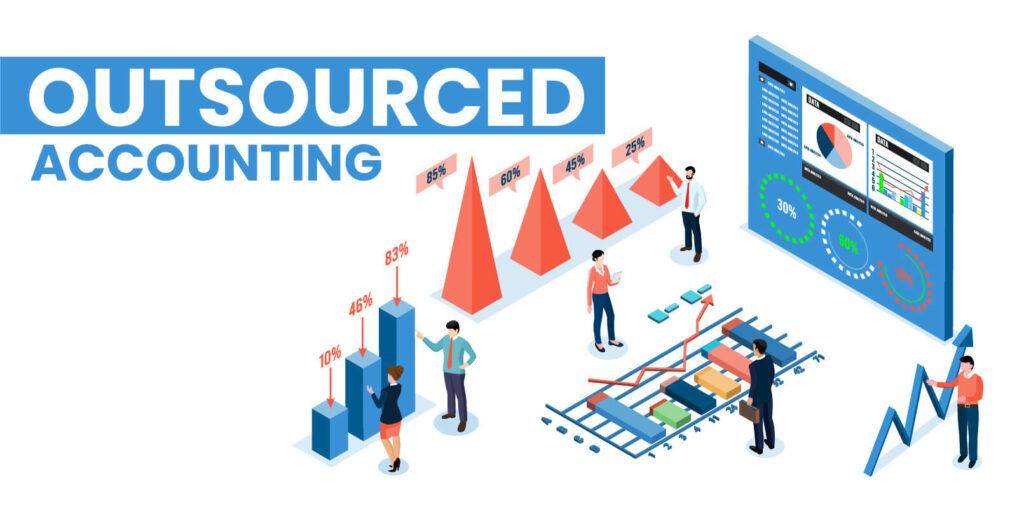
An accounting service includes all operations – direct or ancillary – that are responsible for or contributing to the recording, maintenance, measurement, processing, and communication of financial information of a legal business entity.
Outsourcing and co-sourcing or staff augmentation primarily involve subletting tasks to third parties at terms that are a win-win for both sides.
Formerly, the norm was to have an in-house accounting & finance function/department run by employees who were usually accountants either by virtue of their profession or experience.
However, the trend of outsourcing accounting & finance functions, either in full or in part, grew over the course of time.
According to Fortune, “Almost 54% of all companies use third-party support teams to connect with customers, and 71% of financial service executives outsource or offshore some of their services.”
The key drivers behind outsourcing accounting & finance services are the immense benefits in cost savings, import of specialized skills and expertise, data storage and protection, and redirection of resources into core operations.
Today, outsourcing remains a key practice, including in key consumer industries like the CPG and Food and beverage.
TechTarget states, “Selective outsourcing is a targeted sourcing strategy that relies upon sending very specific functions and work off-premises while keeping other functions on-premises. Off-premises work can be performed either offshore or onshore.”
Before we discuss how selective outsourcing is growing as a popular trend within the outsourcing industry, it is pertinent to clarify here that selective outsourcing and staff augmentation are two different concepts, not to be perceived and used interchangeably.
Toptal defines staff augmentation as “The use of outside personnel on a temporary basis to augment the capacity of your organization.”
The definition above implies that staff augmentation involves importing man-hours or expertise from a third party – the outsourcing or co-sourcing partner – in response to organizational capacity bottlenecks. Conversely, outsourcing or selective outsourcing – as the case may be – involves exporting one or more business processes or processes to a third party for reasons not strictly restricted to capacity bottlenecks.
Accounting & finance were traditionally seen as support functions, but the evolution of business dynamics and practices in the corporate sector has added a strategic lean to it.
Even though hiring outsourced accounting & finance firms and professionals remains common today, the practice of Selective Outsourcing dominates the arena.
According to a research by P. Everaert – a member of the Faculty of Economics and Business Administration from the Department of Accounting and Corporate Finance at Ghent University in Belgium – titled SOURCING STRATEGY OF BELGIAN SMES: EMPIRICAL EVIDENCE FOR THE ACCOUNTING SERVICES, designed as a postal survey sent out to 1200 managers in Belgian small and medium-sized enterprises, at least 53% were found to be using Selective Outsourcing.
Outsourcing of accounting & finance services has also surged in the US, with outsourcing firms delivering services to domestic and overseas clients.
The COVID-19 pandemic, in particular, reinforced the benefits of outsourcing, during which the small and medium-sized enterprises that were formerly shying from hiring outsourced, offshore, or remote resources started joining the league of companies with outsourced accounting & finance.
Quoting a new market study published by Global Industry Analysts Inc. (GIA), Newswire stated: “The Finance and Accounting Outsourcing market in the U.S. is estimated at US$18.3 Billion in the year 2021. The country currently accounts for a 45.7% share in the global market.”
While the pandemic caused huge collateral loss worldwide, it reshaped the social and work-life – reinforcing global values of diversity, inclusiveness, equality, and tolerance that have remote working, outsourcing, co-sourcing or staff augmentation, and offshoring at its fundamentals.
Outsourced accounting & finance services continue to become mainstream in the US, with organizations pursuing savings and expertise in an economy that is persistently growing complex and inflationary.
However, organizations aspiring to outsource their accounting & finance need to exercise a few cautions and watch for a few pitfalls because the success of outsourcing services depends largely on the choice of the outsourcing partner and terms of the outsourcing arrangement.
Yes, by now, we are all convinced that outsourcing accounting & finance functions in full or in part can bring about tremendous benefits, but the next question is: who to outsource to?
There is no shortage of outsourcing firms claiming to provide accounting and finance services, but choosing an outsourcing partner depends on a few key considerations.
Since outsourcing accounting & finance functions in full or in part is a major decision and in fact a strategic one, I must say a detailed initial screening should be carried out before making the final choice.
The following criteria, or a selection framework, may not be an exhaustive one, but is detailed and refined enough to serve as the litmus test for filtering out the best-fit outsourcing partner for you.
This means that the decision to outsource should only come in the face of strategic, tactical, or operational gains, failing which it is advisable to keep this high-profile function in-house.
It further implies that an outsourcing contract should only be entered if you have found your organization’s “right” outsourcing partner.
Based in Greenwich, Connecticut, Expertise Accelerated is an outsourcing & co-sourcing/staff augmentation specialist led by C-suite–level US industry experts leveraging a global talent pool to deliver quality-assured–60% payroll savings.
Expertise Accelerated (EA) CEO Haroon Jafree is a Certified Public Accountant. He has delivered phenomenal savings to notable US companies such as the Sabra Hummus, Safford Roads, and Hillshire Brands.
Expertise Accelerated pursues a hybrid work methodology that combines on-site oversight with off-site resource mobilization to club local and offshore expertise to deliver its clients a high-quality yet affordable outsourcing and co-sourcing/staff augmentation service.
Related searches: