Planning & Analysis
Process Solutions


Most businesses aren’t losing money because the market is tough,They are losing money because they don’t have the right controller.
As a company grows, its finances inevitably become complex. Decisions get hard as the volume of data multiplies. Every day brings new financial choices and requirements. For instance, a company may require a controller to lead its accounting operations or help support the CFO in analyzing and understanding operating results.
A controller will have financial expertise and analytical skills to interpret the data and guide the company to make the right decisions.
The following guide covers:
Before we start, here’s a surprising fact: accounting controller jobs are expected to grow by 17% from 2023 to 2033. Many small business owners hire bookkeepers or CFOs, but not controllers. Yet, it’s one of the most important positions for a company.
A controller ensures that the financial side of the business is going well. He helps business owners see and understand their finances.
In big companies, controllers lead a team of accountants. In small companies, they do all the work themselves. Their job is to keep money organized, correct, and under control so the business can make good decisions.
A Controller is a senior finance professional who manages a company’s money and records. They make sure all financial management is accurate, budgets are on track, and reports are correct. Controllers also help the company follow financial rules and regulations .
A Controller manages a company’s money and financial records. They make sure reports are correct, on time, and follow the rules. They watch budgets, track spending, and lead the accounting team. Controllers also give important financial information to leaders to help make smart business decisions.
Controllers handle money. They plan budgets, watch finances, follow rules, manage cash, spot risks, and help the company earn more. They also explain money matters to managers so the business stays safe and smart.
A Controller runs the accounting department and makes sure the company’s financial management reports are correct. They explain the numbers to managers and other staff. They set up rules to prevent mistakes and fraud, keeping the company’s money safe. Controllers report to the CFO. They watch over Accounting Managers and make sure all reports are finished on time.
An example of a controller’s work is to lead a QBO implementation or migration for a mid-size company that is undergoing transition. A controller will ensure accuracy and execution across the company’s financial operations.
The controllers’ function will revolve around reviewing the books and ensuring that the financial records are accurate. They will check that invoices and expenses are accounted for.
They are responsible for maintaining the cash flow and will work with teams across departments to keep operations humming. A controller will also translate complex numbers into clear insights for the leadership. For instance, helping decide whether to invest in new equipment or adjust the pricing strategy.
Tasks expected from a financial controller vary a great deal according to the industry. But here are a few major tasks that are conventionally expected of a financial controller.
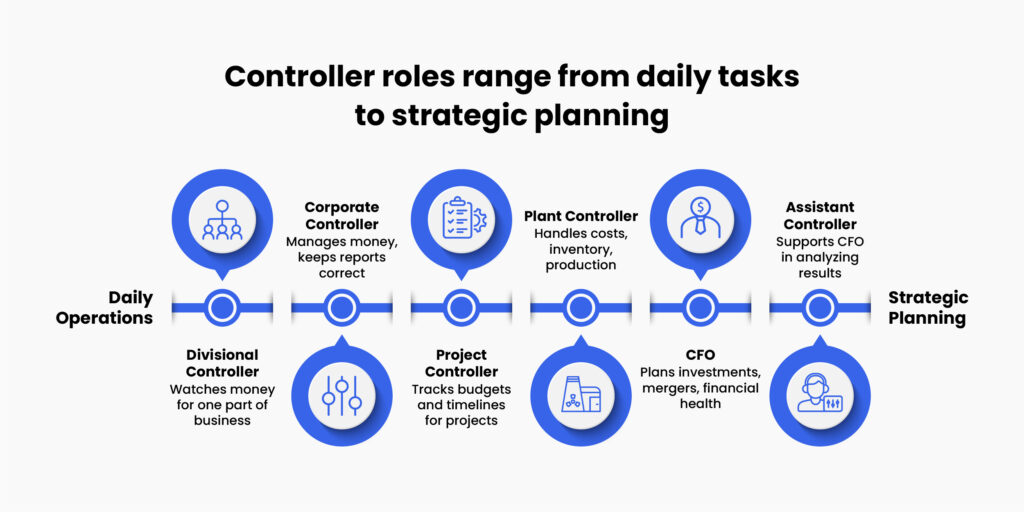
Controllers can have different roles depending on the business.
The right controller depends on your company’s size and needs.
Successful Controllers need to be good with numbers and details. They must clearly explain financial information and lead their team effectively (Indeed). They also need to know accounting rules and follow laws.
Controllers should understand accounting rules (GAAP) and pay close attention to details. They need strong problem-solving and data analysis skills to make sense of financial information. Good communication is also key, as they must explain complex details clearly to teams and managers. Controllers should be able to lead and manage their staff well (Indeed). They need to guide their team, assign tasks, and ensure work is done right. They should also work well with other departments. This helps keep the business running smoothly.
Most controllers study accounting or finance in college. Many also get certificates like CPA or CMA. Some have an MBA. They usually have experience in accounting work.
Controllers use money software like SAP, Oracle, Workday, or QuickBooks. They also use tools for financial close management, like BlackLine or FloQast. Knowing AI, data safety, and data analysis helps controllers make quicker, smarter money decisions.
Controller pay depends on experience, job, and company size. Mid-level pay:
Controllers usually have a degree in Accounting or Finance. Many also get a CPA or MBA. They need to lead teams, know accounting rules, handle budgets, forecasts, and financial reports, and use accounting systems management software (Investopedia). They should work well in busy environments and manage money carefully.
If a company is generating around $1 million in revenue, then they are highly advised to take up a financial controller. Bookkeepers are great at data entry, but controllers handle higher-level accounting and manage the process (Preferred CFO).
Companies undergo financial reporting at an astonishing pace. A running company will go through numbers faster than it will go through water cans for the water cooler. That is why keeping track of the deeper meaning behind financial reports is crucial.
If you’re:
…then it’s time to consider a controller.
Financial controllers come from public accounting & audit backgrounds and usually have big firms in auditing, bookkeeping, and financial assessment. They are experts in GAAP accounting and can review the present data according to IRS standards.
Controllers do daily accounting such as bills, payroll, budgets, and cash flow. They report to the CFO. CFOs plan big through investments, mergers, and financial health improvement plans. The CFO will look for the best ways to grow and improve a company.
An Accounting Manager watches over daily accounting work and reports to a Controller or CFO. They don’t handle big-picture planning. In the CFO vs Controller debate, Controllers lead the accounting team and make sure the company’s finances are correct.
Controllers keep money accurate, follow rules, and guide the business. Without them, companies can make mistakes or lose money.
Here we explain the difference so that you can decide for yourself (Fully Accountable):
| Fractional Controller | Full-Time Controller | |
| Definition | Part-time financial expert who helps with tasks like closing the books, reviewing reports, or implementing systems | Fully involved in daily operations, long-term planning, and managing larger accounting teams. |
| Purpose | Provides flexible, targeted support when needed | Manages ongoing financial operations and drives strategy. |
| Involvement | Limited, project- or part-time basis | Daily, deeply embedded in the business. |
| Team Management | Usually does not manage a large team | Leads and manages accounting/finance teams. |
| Cost | Lower, pay only for needed hours | Higher, full salary and benefits. |
| Best For | Small or growing companies needing expertise without full-time cost. | Larger companies need continuous oversight and strategic planning. |
| Decision Factors | Company size, complexity, growth plans, and budget. | Company size, complexity, growth plans, and budget. |
Finally, what does a controller do? Controllers are top money managers. They make sure reports are correct, rules are followed, and budgets are right. They lead the accounting team and help bosses understand the numbers.
Controllers are important for companies with lots of money to handle. The job can grow your career. Many become VP of Finance, CFO, or COO. If you like numbers, being careful, and leading people, being a controller is a good job.
Is a controller a stressful job?
Controllers play a critical role in the financial well-being of a company. They have an owner and a client-facing, highly accountable role. But if one is good at it, then it does not have to be stressful.
Is a controller higher than a CPA?
A CPA is usually hired as an accounting manager, which is higher than a controller. MBAs are conventionally chosen as a controller.
What is a controller vs a CFO?
It is a debate whether a controller is higher than a CFO. A CFO is a Chief Financial Officer, while a controller is responsible for managing all financial activities of the company. A CFO is higher than a controller, and a controller conventionally answers to a CFO.
Is a controller a high-level job?
Yes, a controller manages the financial activity of the company and ensures that all financial information is effectively used and gathered.