Skip to content
Accounting
Audit
Planning & Analysis
Process Solutions
Operations



Everything independent contractors need to know to keep accurate financials.
For most contractors, bookkeeping is handled reactively. Something goes wrong, or tax season arrives, and suddenly there is a month of transactions to sort through. Invoices are going out, payments are landing late, expenses are spread across accounts, and quarterly tax deadlines are hitting faster than expected.
It does not have to work that way. Contractors who stay on top of their finances have a system. This guide covers what that system looks like, from income tracking to software to what happens if you skip the quarterly payments.
Online accounting and bookkeeping services help contractors have a proper setup from day one.
Ask ten contractors what bookkeeping means. Most will say receipts and taxes. That covers maybe half of it.
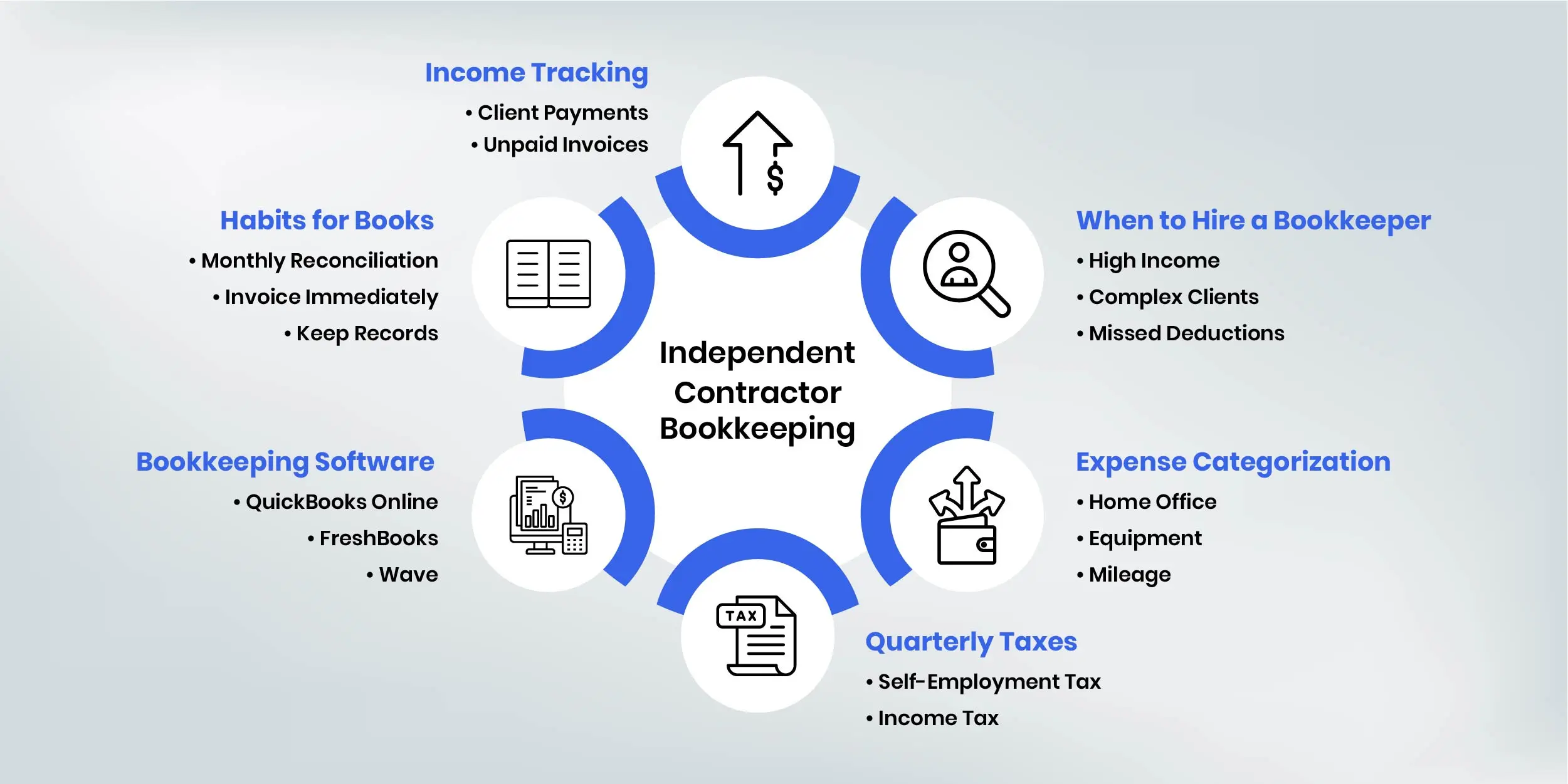
Independent contractor bookkeeping is four things: tracking income, recording business expenses, paying quarterly taxes on time, and keeping business money separate from personal money. Those four, handled consistently, account for most of what goes wrong when contractors leave their books alone for months. This is not complicated but it is just ignored until it becomes a problem.
The complication is irregular income. An employee gets paid on a schedule. Contractors get paid when clients pay, which is often not when the invoice goes out. Income arrives in batches. Some weeks, three clients pay. Other weeks, nothing. Expenses do not follow a calendar either.
Without a system for managing contractor finances, transactions pile up. By the time tax season arrives, there is guesswork involved. Guesswork means missed deductions, wrong quarterly estimates, and sometimes penalties.
Getting started is the hard part for most people.
One account for business. One for personal use. This is the foundation of organized bookkeeping for independent contractors, and it is the step most people skip when they first go out on their own.
Mixing personal and business transactions creates two problems. First, every transaction needs to be sorted manually before it can be categorized. Grocery runs, client payments, coffee, and software subscriptions, all in one statement. Second, if the IRS ever asks questions, a commingled account makes it hard to prove which expenses were actually business-related.
A dedicated business account means every deposit is income, every payment out is an expense. Reconciliation takes from an hour to ten minutes.
Add a business credit card and use it only for work spending. Pay it from the business account. That combination creates an automatic log of every deductible purchase without extra effort.
Every payment gets logged. Date, amount, client name. That is the starting point.
Beyond that, know what has gone out on an invoice but has not come back as cash. A contractor with $15,000 in unpaid invoices does not have $15,000. They have promises. Knowing the gap between what clients owe and what is sitting in the account is what separates contractors who plan from those who get caught short.
Not all income arrives with a 1099-NEC attached. Clients who paid $600 or more during the year are supposed to send one by January 31. Some forget. Some are late. Clients who paid under $600 have no obligation to send anything. None of this affects what the IRS wants from you. Every dollar goes in the return. A $350 payment from a one-time client who never sends a form still gets reported. Your records are the backup, not theirs.
Pick an invoicing process for consistent numbering, payment terms written on every invoice, a follow-up routine for anything overdue. Late payments happen in every contracting business. The difference is whether chasing them runs on a system or gets handled differently each time a client goes quiet. A reminder at one week past due. Another at two. A phone call in thirty days. The exact steps matter less than having steps and using them every time.
Business expenses reduce taxable income. Most contractors claim the obvious ones and leave a meaningful portion behind.
The IRS test is whether an expense is ordinary and necessary for the type of work being done. That covers more than most people assume.
Documentation is the real problem, not knowing what qualifies. An expense logged the same day with a receipt is clean. The same charge reconstructed from a bank statement three months later is a guess. Photograph receipts as they happen. Most apps take ten seconds.
No employer withholds taxes on contractor income. That falls on the contractor, four times a year.
Self-employment tax is 15.3%, covering Social Security and Medicare. Income tax sits on top, based on total annual earnings. A large chunk of every payment is already owed before it gets spent. Pulling 25 to 30% out of each payment and keeping it separate is the standard approach.
2025 deadlines: April 15, June 16, September 15, January 15, 2026. The periods are uneven. Q1 is January through March. Q2 is April and May only. Q3 is June through August. Q4 is September through December. Q2 trips people up regularly because it covers two months, not three.
Two ways to calculate the payment. Pay 90% of this year’s estimated liability spread across four quarters. Or take last year’s total tax bill, divide by four, and pay that amount each quarter. An income over $150,000 last year means the figure is 110% rather than 100%. This is the safe harbor method. Income can rise during the year, and penalties still do not apply as long as payments go out on time.
Good cash flow tracking for freelancers matters most around these dates. Knowing a payment is due in five weeks changes how the money in the account is managed.
This year-end accounting checklist covers how quarterly planning connects to annual filing obligations.
Two accounting methods exist. Most contractors use one and do not know the difference.
Cash basis records income when received and expenses when paid. A payment that arrives in December shows as December income, regardless of when the work happened. This matches the actual bank balance and is simpler to maintain.
Accrual basis records income when earned and expenses when incurred, regardless of cash movement. Work completed in November shows as November income even if the client pays in January. Accruals give a more accurate picture of business performance but add complexity.
For solo contractors and small freelance operations, the cash basis handles most situations well. Accrual becomes relevant if there are large outstanding invoices regularly, or if applying for financing, where a lender wants to see earned revenue rather than collected revenue.
The method should be chosen before the books are set up, not after several months of mixed recording.
Spreadsheets handle the early months. Once transaction volume builds, manual entry becomes a time problem.
Three questions before choosing: Does it pull transactions from the bank automatically? Does it estimate quarterly tax liability as income is recorded? Can it produce a profit and loss report that the accountant can work with? If all three are yes, it is worth a trial.
A closer look at professional bookkeeping support and what it covers is in this guide on what a bookkeeper does.
Tax season is not the problem for contractors who handle their books consistently. It is an event they prepared for. Here is what consistent looks like.
For contractors managing freelance work alongside more structured small business obligations.
Some contractors manage their own books indefinitely. Most hit a point where the time cost stops making sense.
Income crossing $75,000 a year. Multiple clients with different payment structures. Quarterly estimates that involve more guessing than calculating. The financial admin is eating two or three hours a month that could have been billed. Any one of those is a signal. All four together, and the decision is obvious.
A bookkeeper takes the whole thing off the plate and usually finds deductions that were being missed along the way.
What a bookkeeper costs varies by scope and experience. Here, a guide on bookkeeper costs breaks down what to expect at different service levels.
Contractors who know their numbers stay profitable. Those who do not find out what they missed when the quarterly deadline passes, or when a deduction they were entitled to goes unclaimed for three years running.
Good independent contractor bookkeeping does not require an accounting background. It requires a dedicated account, a consistent habit of logging income and expenses, software that pulls it together, and quarterly payments made on schedule.
Build the system early. The workload only grows.
Yes. Running everything through one account sounds manageable until three months of transactions need sorting, and half of them could go either way. Business or personal? Hard to say when it’s all mixed.
A dedicated account removes that problem. Every deposit is income. Every payment out is an expense. The IRS also responds better to a clean business account than a personal one with work charges buried inside it. It takes 30 minutes to open. Saves hours every quarter.
Most contractors claim too little. Home office space used only for work, laptops, software subscriptions, mileage to client locations, health insurance premiums, accounting fees, legal fees, advertising costs, and business travel.
The IRS asks whether the expense is ordinary and necessary for the work. Most work-related spending passes that test. What fails is the documentation. A receipt captured the same day holds up. A bank charge from four months back with no context attached is harder to explain.
Employers do not withhold taxes from contractor payments, so the IRS wants money throughout the year rather than one lump sum in April. Four payment dates: April, June, September, and January.
Each payment covers income tax plus 15.3% self-employment tax for Social Security and Medicare. The safe harbor method keeps it simple: take last year’s total tax bill, divide by four, and pay that amount each quarter. Income can go up significantly, and penalties still do not apply.
Cash basis records money when it actually moves. December payment shows as December income. The March bill shows as a March expense. Matches the bank statement exactly. Most contractors use this.
Accrual records transactions when they occur, regardless of payment timing. November work counts as November income even if the client pays in February. A more accurate picture of how the business is performing, but more to track daily. Matters more when invoices regularly sit unpaid for long periods, or when applying for financing.
Three years from the filing date for most situations. That is the standard IRS window. If underreporting of 25% or more is suspected, six years. No limit on fraud cases.
Keep 1099s, bank statements, receipts, mileage logs, and contracts. Scanned copies are fine. A cloud folder sorted by year beats a drawer of paper and is faster to search when something comes up.
Wave is free for income tracking, expense categorization, invoicing, and basic reports. Works for contractors, keeping costs low. QuickBooks Solopreneur adds mileage tracking, receipt capture, and better tax reporting.
Worth paying for once income is steady. FreshBooks fits contractors who send a lot of invoices and need solid project billing. All three can be used without any accounting background.
When bookkeeping eats into time that could be billed. Past $60,000 to $70,000 in annual revenue, or when income runs across several sources with different tax treatment, the admin starts adding up. Quarterly estimates get harder to calculate accurately. Deductions get missed. The bookkeeper’s fee is itself a deductible expense, and most pay for themselves through what they recover in overlooked write-offs.