Planning & Analysis
Process Solutions


Understand supply chain analytics to optimize operations, cut costs, and predict demand
What is supply chain analytics and why has it never been more relevant?
Imagine a shipment was supposed to come on Tuesday. But the warehouse is still waiting for the shipment on Thursday. The operations team scrambles to minimize further disruption. The production schedules have to be moved around, and customer orders are postponed.
The information was already there in supplier updates, in logistics systems and demand forecasts, but no one had a clear picture of the complete supply chain situation.
This is often the reality of supply chains. They are susceptible to interruptions especially if they are international and multifaceted.
Gartner points out that over 80% of supply chain leaders point to volatility as their greatest challenge. This is where supply chain analytics comes in.
Inventory, logistics, demand planning, and supplier performance help businesses identify risks sooner, predict the demand more precisely, and make timely and smarter decisions. Simply put, supply chain analytics takes complexity and turns it into visibility and visibility into improved performance.
In the podcast episode of Supply Chain Now, practitioners stress that analytics is no longer a luxury or a nice-to-have; It is a competitive advantage that enables smarter decisions. Likewise, organizations that have adopted data analytics are more efficient in their operations.
Concisely, supply chain analytics provide a quantifiable performance output.
What does supply chain analytics mean? In addition to dashboards and reports, supply chain analytics is the data integration from the ERP systems, warehouse management, transportation networks, and supplier portals to achieve one vision of the whole supply chain.
This transparency helps the organizations to identify inefficiencies, predict disruptions, and make proactive decisions instead of responding to crises.
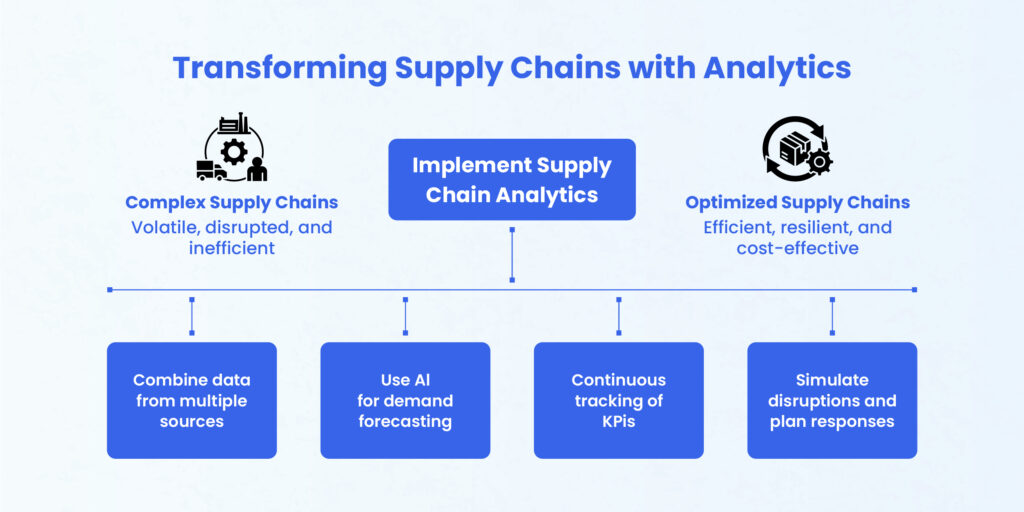
Practically, analytics converts raw operational data into actionable data. As an example, companies will be able to manage inventory more efficiently, eliminate overstocking and stockouts. They can analyze warehouse performance, find areas of low performance or labor, and manage transportation performance, including tracking delays, route savings, and freight expenses.
Companies such as Unilever and Procter and Gamble testify to the fact that centralized supply chain visibility using analytics has saved the companies up to 15 percentage points in terms of inventory hold costs, and improved services.
SAP Integrated Business Planning (IBP) and Kinaxis RapidResponse platforms use data aggregated from multiple sources to provide real-time supply chain information, including suppliers, logistics, and inventory. This facilitates quick scenario modelling in case of demand spikes, disruptions, or supplier delays.
Advanced analytics will monitor the order fulfillment rates and lead times, as well as on-time delivery rates. Through the detection of trends and deviations early, organizations can rectify the inefficiencies in advance, thereby making operations cheaper and more reliable in the provision of services.
If managing these analytics in-house feels overwhelming, exploring demand and supply chain outsourcing can give you access to expert capabilities without building them from scratch.
What is supply chain analytics with respect to optimization? It allows companies to utilize historical data, real-time inputs, and predictive models to make smarter decisions in inventory, production, and supplier networks.
Analytics enables companies to balance the supply and demand in real time, to optimise resources, cut down costs, and enhance the level of service.
In particular, machine learning and AI-based predictive demand forecasting rely on the analysis of the previous sales patterns, seasonality, and market trends. This reduces stockouts and overstocking that would cause production to be ahead of the real customer demand.
Other companies, such as Walmart and Nestle, use predictive models to match supply and regional demand, thus saving millions in inventory carrying costs and also improving order fulfillment.
The better models predict the dynamic customer demand, supplier lead time, and market volatility. Combining real-time sales information with predictive analytics will help firms to reshape production arrangements, optimize safety inventory, and minimize the unwarranted holding expenses.
With the help of algorithms and past route statistics, businesses achieve optimal transportation routes, lowering fuel and labor expenses, and increasing the speed of delivery.
Logistics systems such as FourKites and Project44 support live tracking and forecasting TETAs to enable planners to plan shipments proactively during disruptions, weather, or ports incurring delays.
The following section draws attention to how analytics can be used to turn supply chains into predictive, optimised networks where every decision made, be it of inventory levels or routing, is a contribution to cost saving, efficiency, and customer satisfaction.
What is supply chain analytics in the modern world? In addition to visibility and predictability, advanced analytics uses real-time streams of data and AI, and big data to enable proactive and predictive decisions.
Top companies are leaving behind the old reporting methods and adopting continuous monitoring and scenario modeling, which involves cloud computing that can be used to identify risks, streamline processes, and react swiftly to failures.
The recent trends are:
Experts note that organizations that have adopted real-time analytics and AI modelling have reported faster response time, a reduction in bottlenecks, and enhanced collaboration among the suppliers.
Predictive insights have become the means of measuring reliability, compliance, and efficiency for companies. Analytics follows the on-time delivery, quality metrics, and adherence to the contractual agreement to ensure that the business identifies the suppliers who do a good job and go ahead to deal with risks proactively. Such systems are applied by firms such as Unilever and Johnson & Johnson to bargain for more advantageous conditions and provide stability.
Advanced analytics forecasts the bottlenecks, capacity limitations, and shipment delays. Project44 and FourKites are some of the platforms that unify GPS and traffic data, warehouse information to streamline routes, lower freight expenses, and deliver faster. Scenario modeling enables firms to model disruptions and rearrange operations prior to delays affecting the customers.
The practice emphasizes the fact that advanced analytics and industry trends, namely AI, big data, cloud computing, and real-time monitoring, are turning supply chains into intelligent and adaptable networks that have the potential to lower costs, increase efficiency, and improve services.
To be effective in their use of analytics, modern supply chains are also based on digital tools and software. These platforms enable organizations to analyze, visualize, and take action on complex supply chain data in real-time and in predictive modeling, no matter what type of data they have.
The important tools and platforms that are widely applied in industry are:
The best practices in the industry supported by the tools are:
Through the combination of the said digital solutions and analytics platforms, organizations can continuously track performance and model scenarios, make proactive and data-driven decisions, which reinforce overall supply chain resilience.
What is supply chain analytics? Fundamentally, it is the act of converting intricate data of operations into practical revelations, which leads to smarter decisions. Analytics help organizations have better visibility, operational efficiency, and lower costs, as well as alignment of production, logistics, and procurement to strategic goals.
Supply chain analytics is beneficial in many ways. Between improving the performance of supply chains with predictive forecasts and facilitating transformation based on analytics, businesses can monitor supply chain performance rates, address risk early, and enhance supply chain supplier relationships.
In prospect, AI-driven insights, cloud-based monitoring, and integrated data platforms will become the future of supply chain analytics that will allow continuous optimization. Companies that have adopted this strategy are not only making sure that operations are becoming better. Instead, they are creating resilient, cost-effective, and agile supply chains that can respond to market changes, reduce disruption, and ensure long-term growth.