Planning & Analysis
Process Solutions


Why Shared Services Are No Longer For Fortune 100 Companies Only?
The majority of CPG leaders know the term Shared Services Center (SSC); however, very few are aware of what it entails in terms of a $30M -75M business.
Basically, a Shared Services Center is a central operating model in which the key accounting operations, i.e., accounts payable, accounts receivable, reporting, close and trade management, are centralized, standardized, and controlled with active ownership of the processes.
An SSC is neither traditional outsourcing nor merely offshoring work to cut costs. It is a restatement of the way finance works. This distinction matters because in a Shared Services model the processes are identified, recorded, and quantified, leading to increased transparency, control, and consistency.
Fortune 100 companies realized this benefit several decades ago. These companies developed internal shared services systems that allowed them to reduce the costs of operation, standardize operations, make financial visibility real-time, and provide more consistent CFO-level reporting.
In the past, this model was too expensive and complicated to be accessible to the mid-market companies.
That limitation is no longer the case.
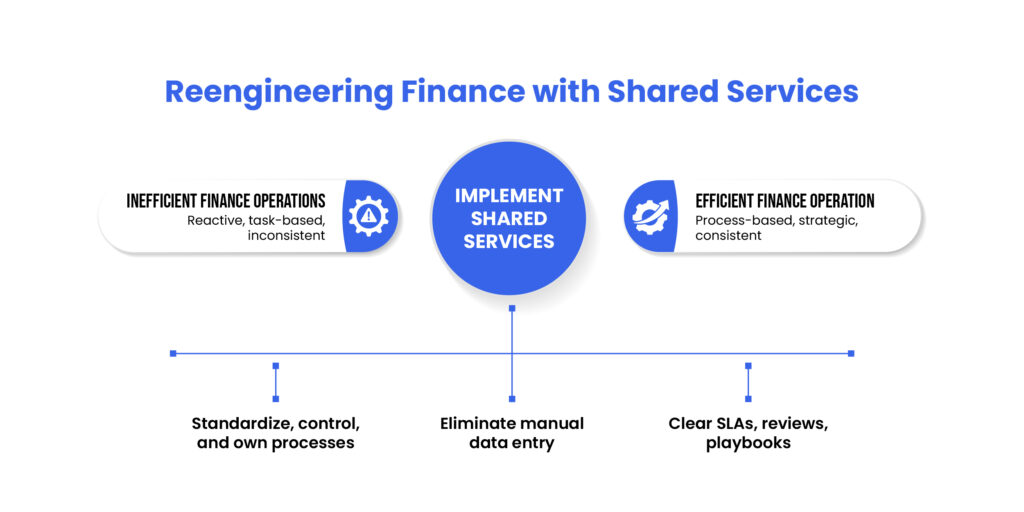
As technology has advanced, integration has become a reality, and managed service models have matured. Mid-market CPG companies are now able to have access to the same operating structure without spending money on infrastructural development.
This change is bridging the gap that has been in existence between enterprise and mid-market finance capacity.
For mature CPG companies, it is no longer a matter of whether shared services is a relevant concept, but rather a matter of whether their existing model can enable the next level of growth.
Do you have the right teams, processes and systems in place that enable growth instead of preventing it?
The concept of a shared services center is simple. Consolidate finance and accounting functions that are currently being done inconsistently and in different places within an organization, centralize them under a single service model, and run them in standard processes, with special expertise and responsibility. What is produced as a result is a cheaper, more efficient, and scalable finance operation that has no proportional overhead (Survey).
In the case of CPG and manufacturing companies, especially, this model will solve a long-standing issue in that the finance function often becomes reactive, creating new positions and tasks to meet the urgent need, but not strategically. The shared services centers present the opportunity to take a step back, reinvent the actual flow of finance work, and establish an operation that is process-based and is not based on individual heroics.
Let’s find out the processes that work within a well-operating shared services center.
Here are some examples of the functions that are commonly transitioned into a shared services center structure:
Accounts Payable includes receipt of invoices, coding, matching, routing of approvals, and payment of vendors. Among the most widely offloaded functions – large volumes, clear-cut rules, and substantial consolidation- plus early-pay-discount take-off savings.
Invoicing and application of cash to the customer, analysis of aging and collections outreach. This in CPG in particular involves dealing with retailer payment cycles and the more complicated deduction and chargeback conflicts that will eat the margin, unless they are addressed.
Purchasing of journal entries, account reconciliations, intercompany accounting, and management of the monthly and quarterly close cycle. The close process is standardized by using an SSC, and this hugely decreases the cycle time and reporting accuracy.
Management reporting, variance analysis, KPI dashboards, CFO level reporting packages. An SSC provides a high level of regular and prompt reporting with the help of multiple internal analysts who are not available or overstretched to the point of ineffectiveness.
In the case of manufacturing and CPG businesses, these are standard costing, inventory pricing, cost-of-goods analysis, and variance tracking. Without strict cost accounting discipline, there is no way to come to terms with what the product-level profitability really is.
Computation of payroll, tax returns, compliance, and administration of employee information. Payroll can be integrated as part of a shared services model with sufficient controls and access to the system, although it is often outsourced to payroll-specific vendors.
Often companies utilize a shared service center because of the systems, processes, and specialized knowledge of their teams and the best industry practices they follow.
Areas like trade promotions management in the CPG industry require CPG specialists, as this is where many companies lose their margins and may have limited visibility. Companies like Expertise Accelerated work as a shared service center, helping their clients manage these processes and achieve great cost savings.
The difference is more than what the majority of people know. Conventional BPO is business process outsourcing, which is task-oriented. A vendor is given work, does it, and hands it back. The process is not owned, there is no investment in making the workflow better, and there is no strategic insight into what the result of the work is to the business.
Shared services centers are run in a different manner. The team is in possession of the function rather than only the task. It implies the way the process will be executed, documentation keeping, exception flagging, controls, and constant enhancement of the way the work will be done. The disparity in performance – in accuracy, speed, and business acumen – is wide.
| Dimension | Traditional BPO | Shared Services Center |
| What they own | Individual tasks | End-to-end process |
| Process design | Defined by client | Designed and optimized by SSC |
| Business insight | Limited — output only | KPIs, dashboards, CFO reporting |
| Expertise depth | Generalist, often pooled | Dedicated, industry-specific |
| Scalability | Volume-based | Structural — grows with business |
| Governance | SLA and ticket-based | Monthly reviews and KPI dashboards |
The fiscal gains of shared services centers are not realized mainly because of labor arbitrage, but because of the standardization of the process. In case of multiple approaches to the same task by many individuals, mistakes are multiple, reconciliations are protracted, and reporting is not real-time. Unifying the manner in which any process will operate, and making the same standardized and applied across the board, eradicates the unseen cost of dissimilarity.
Shared services centers do not simply perform your finance jobs at a lower cost, but they construct the operating infrastructure that your team simply had no time to develop.
That translates to, in practice, the SSC records all processes, such as invoice coding and approval, the close checklist process, deductions dispute, and tracking. Such documentation turns into institutional knowledge that does not go through the door with an employee. It provides continuity, a shorter onboarding period to new hires, and provides leadership with operational transparency that enables them to trust the figures.
Automation in shared services is not the act of dropping people, but it is the elimination of the labour that does not involve a human being in the first place. Data entry, match of invoices, scheduling payments, generating reports, etc., all these could be automated more or less, and the SSC team could concentrate on the judgmental tasks: exceptions, disputes, analysis, and communication with their business partners.
Three-way matching and invoice processing, Automated payment operations and discount capture, Recurring journal entries, Close checklists and work tracking, Accounts receivable aging notifications * KPI dashboard and report distribution
The effective advantage is multiplication. Automation decreases the cost per transaction. It also minimizes the error rates – this minimizes the amount of time wasted in corrections, re-reconciliations, and audits. And it generates a quicker, cleaner close process that provides leadership with more dependable figures, sooner.
Governance structure is one of the benefits of a shared services center that is undervalued. Expanding companies do not necessarily have a formal operation of finance operations control – there are no standard KPIs, no put-on-record escalation routes, no monthly review on how the finance function itself is doing. That is the discipline introduced by an SSC.
A fully developed SSC governance model will generally consist of the following:
This is the layer of governance that divides an SSC and a staffing arrangement. The aim is not to have someone doing the work but to have the work running like a controlled, quantifiable, and better way.
During one of his most recent engagements, CFO Haroon Jafree gave an example of a previous experience in his career when he was in-charge of the finance of a business with a budget of 30-40M.
At the moment, the company was expanding rapidly and its finance department was expanding in a reactive manner, which is adding personnel to cope with the growing complexity and not reorganizing the manner in which the work was performed.
Rather than following the same direction, he introduced a shared services model – this is a popular strategy in large companies, but one that is seldom organized effectively in mid-sized businesses.
The effect was instant and quantifiable:
The greatest change, however, was not necessarily financial.
It was operational.
The finance department transitioned to a process-based system that was reactive and task-based. Reporting improved, top management became confident in the numbers, and decision-making also improved throughout the organization.
The point that this example brings out is a larger one:
Shared services is not merely a cost reduction measure – it is a method of reengineering the operation of finance on scale.
The obstacles previously available to this model, only to large businesses, have been removed to a large extent due to the availability of modern tools and infrastructure. The same concepts could now be applied by mid-market companies without the past complication.
With finance executives, it is no longer a matter of whether shared services work or not, but whether their existing operating model is crippling them.
Shared service centers are appropriate for large companies that have complex finance operations, but the companies are not large enough to develop enterprise-grade process infrastructure internally.
In the case of CPG and manufacturing companies, this generally translates to the range of companies between $10M and above in revenue. These companies have trade promotions, inventory accounting, and retailer relationships that produce specialized needs that generic finance outsourcing is simply incapable of addressing.
The model is also especially useful when there is growth or even transition. When a company is growing at a rapid pace, introducing internal staff to the finance department results in fixed costs difficult to remove. An SSC offers an operational paradigm that is available when needed, and that is available when it is scaled up in the business, without the organizational cruft of a full-scale internal center.
To companies whose complexity is CPG specific, trade spend, and retailer chargebacks, and promotional accruals, SKU-level costing, the appropriate SSC partner offers not only capacity to operate, but industry experience that bridges the gap between what the company requires and what can be offered by a generalist team.