Planning & Analysis
Process Solutions


The business is performing well on the surface. But when you open your bank account, you find a difference in the figures.
Why is bookkeeping in e-commerce more difficult than it should be?
It usually starts in the same way.
You check your store dashboard, and it is a fabulous sales day – hundreds of orders, revenues are good, and the growth is in a positive direction. The business is performing well on the surface. But when you open your bank account, you find a difference in the figures.
The payment processors have had their share. A batch of returns has been debited. Advertising expenditure has decreased margins. There is no real-time data on inventory visibility by SKU or warehouse location.
What seemed to be profit on the upper line starts to fall apart in one adjustment after another, with fees and delays.
This is the reality of e-commerce accounting.
The lack of a systematic approach to the financial management of e-commerce, even in the stores that grow by leaps and bounds, affects cash flow management, profit calculation, and decisions. And there the true challenge – and chance begins.
Key Takeaways:
The problem of e-commerce bookkeeping does not occur due to the absence of data; it occurs due to the abundance of it. The seemingly straightforward sale is actually a series of money transactions captured in varying ways by your store, your payment processor, and your bank.
In a conventional business, it is much easier to know the revenue, you send the invoices, get the payments, and put them on record. In e-commerce, that simplicity is gone nearly at once.
A web-based shop that is based on such online shopping platforms as Shopify or WooCommerce may have hundreds or thousands of small transactions daily. However, those individual sales are never paid at the same time. Rather, they are combined in payouts that consist of more than one day of activity, overlapped with modulations that are not always obvious at the surface.
When money goes to your bank, it has already been whittled down by payment processors such as Stripe or PayPal. Through these platforms, they deduct fees, refunds, and at times reserve or withhold settlements. Then the figure you have spread in your account is not your revenue, but a net result of various calculations that cannot be seen.
This brings about a structural disconnection. Your store shows gross sales. Adjusted transactions are displayed in your payment processor. Your bank shows the final cash. None of these reconcile easily with intentional reconciliation.
Revenue in e-commerce does not come to your bank, and it will have to be reconstructed by integrating information in your store, payment systems, and financial statements.
The sale of Amazon provides a totally new accounting framework. Amazon does not issue transaction-level payouts but instead issues settlement reports that aggregate all of them (sales, fees, returns, storage costs, and even advertising spend) into one payment. As per the seller’s advice on Amazon, what is delivered to you is not exactly an expression of what was carried out in terms of sales, but your net settlement amount.
This implies that a seller cannot trust bank deposits or even platform summits to know the performance. They must de-settle every settlement, distinguish between revenue and fees, and find adjustments that can be relevant to previous periods, e.g., missed returns or reimbursements.
The case is further complicated when you add in the payment gateways such as Stripe or PayPal. Both systems have their timing differences, deductions, and reporting forms.
The studies of companies such as Gartner point to poor reconciliation processes within e-commerce as the main cause of overstated revenues, expenses that are not incurred, and failure of profitability analysis, not due to lack of data, but due to poor linkage between the data.
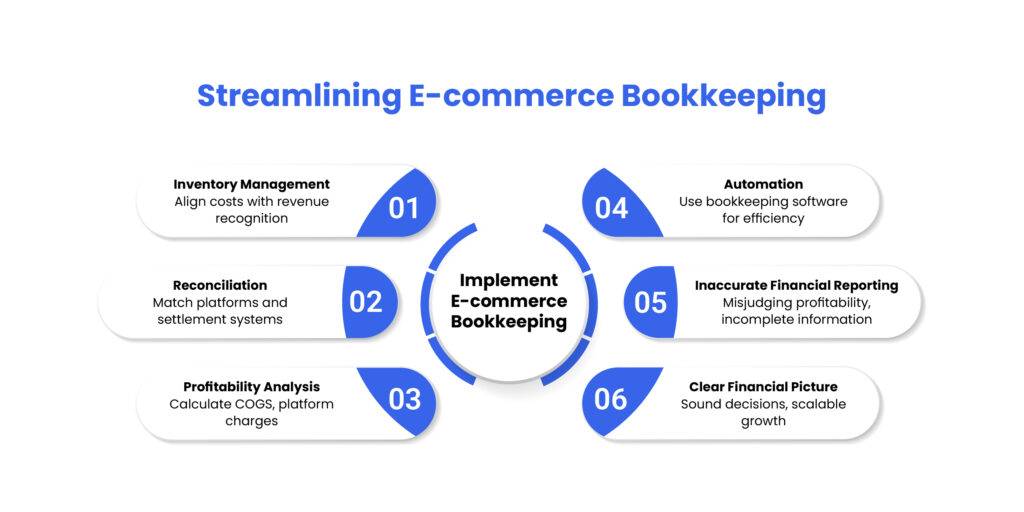
E-commerce bookkeeping does not necessitate recording of transactions as much as it involves reconciling platforms and settlement systems, and when all sources of data are matched, then it becomes accurate.
The majority of e-commerce companies think that they know their inventory numbers best, and they often prove to be the most misguided. It is not just a matter of tracking stock but aligning the timing of costs incurred with the timing of recognition of revenue, which will always be distorted unless it is well managed.
Consider a simple scenario. In the e-commerce industry, a brand can use 50,000 dollars in advance to stock up. The reason behind this is that the money is no longer part of the business, but the products only take 2-3 months to sell.
Meanwhile, it also begins to get sales on the business side. The earnings appear to be strong in print. However, when such sales are not properly recorded against the COGS, then it is seen that there has been an overstating of the margins. The business can make the assumption that it is highly profitable, but most of the cash is held in the business.
In inventory accounting, the distribution of costs per sale is done either by FIFO (first-in, first-out) or by weighted average. They can portray an enormous distortion of the profit and loss statements in the case of their improper or even unequal use.
That is why most of the e-commerce entrepreneurs are not only profitable, but also cash-strapped. It is a disconnection that is inventory-based and not sales-based.
In e-commerce, the profitability of inventory must go hand-in-hand with the sales, per se, and not vice versa.
Among the greatest misconceptions in e-commerce is that good sales make good profitability. Practically, most thriving companies are run on false-positive profitability, where the revenue impresses the eye, but the margins are quietly draining under the carpet, as a result of poor financial visibility and recognition of costs.
Such a disconnect occurs due to the fact that e-commerce financial data is distributed among more than one system, and it is not often consolidated in a single system that is reliable. This leads to the fact that founders tend to make decisions relying on incomplete or inappropriate information. The most commonly met problems are:
The sale can be registered in such a platform as Shopify or WooCommerce, and payment is made with Stripe or PayPal. Concurrently, advertising expenses, inventory and logistics information reside in different tools. The business is failing to work with an integrated financial picture without sufficient consolidation.
Revenue is usually recorded when a sale has occurred, whereas refunds, returns, and chargebacks are recorded at a later stage. Likewise, the inventory cost is experienced in the initial period but is reduced with time as the products are sold. Such timing lapses can inflate the profitability temporarily when they are not matched in the books.
What looks like a profitable product when viewed on the overall business level might be found to have very different margins when apportioned at the SKU level or channel level, including platform charges, shipping, and advertising. In the absence of such detail, the scaling decisions can be made on unfinished information.
Most of the businesses use sales dashboards or bank balances instead of reconciled financial statements. This implies that charges, payments, and other operational expenses are not necessarily covered in an organized manner, thus creating discrepancies between the figures reported and performance.
The cost structure of different sales channels can vary greatly. Businesses will not be able to weigh the profitability of this channel and product, and therefore might end up investing in channels that do not add value to their overall margins.
In order to cope with these issues, those e-commerce companies that have reached an adequate level of financial maturity shift towards integrated reporting and regular reconciliation. Their interests lie in knowing contribution margins, matching costs with revenues, and performance analysis, both at the product and channel levels. This will enable them to go beyond the superficial sales measures and develop a more concrete picture of actual profitability.
In the long run, it should not only be a matter of tracking the revenue, but also what is left after everything is duly counted in the form of expenses. In e-commerce, the financial lack of transparency will lead to the illusion of success, whereas in practice, the profitability does not necessarily match the growth.
In order to execute proper e-commerce bookkeeping, you need particular tools, workflow best practices in the industry, integration practices that are consistent with the realities of e-commerce, and not general conjecture.
QuickBooks Online (QBO) is among the most popularly recommended ecommerce bookkeeping programs as it allows integration of dozens of ecommerce applications, which monitor transactions, fees, and payouts in a single general ledger.
Another mainstream accounting system that is favored by e-commerce businesses selling internationally is Xero, due to its capability to deal with multiple currencies, foreign exchange, and bank feeds.
A2X is a dedicated reconciliation service that incorporates Amazon, Shopify, and eBay payments into QuickBooks or Xero by automatically matching sales, fees, refunds, and taxes to the appropriate accounting object.
Stitch Labs (through Square) and SkuVault are used to make sure that inventory moves to the financials are accurate, and that errors in reporting do not happen due to the stock levels not being included in accounting systems.
TradeGecko (now QuickBooks Commerce) then synchronizes the inventory movements with books, such that when you sell, receive, destroy, or transfer a product between warehouses, the changes automatically update your books.
Katana MRP is useful to e-commerce brands that produce or package their goods, since it includes real-time tracking of their inventory and production costs, and accounting software such as QuickBooks and Xero.
Sellbrite and ChannelAdvisor assist the multi-channel sellers to consolidate inventory across marketplaces (Amazon, Walmart Marketplace, Etsy) and input that data into accounting systems, and remove errors in the count of stock.
Fathom and Spotlight Reporting are financial analytics applications that connect to QuickBooks or Xero to generate powerful profit & loss statements, cash flow projections, as well as segment performance – such as by sales channel or product line.
LivePlan enables e-commerce companies to create financial forecasts that are not merely reports, enabling them to plan scenarios on how to purchase inventory, spend on advertising and view pressure on the margin.
Baremetrics integrates with payment vendors such as Stripe and subscription engines to give clean dashboards of recurring revenues, churn statistics and trends of cash flows, which current accounting systems do not naturally track.
The optimal approach to e-commerce bookkeeping is to have the connections between your sales platforms (Shopify, Amazon, eBay), payment processors (Stripe, PayPal), and your accounting platform (QuickBooks/Xero) involving middle-layer integrations (such as A2X, Zapier, or native APIs) so that the data transfers automatically without manual cleaning.
The SKU-based cost allocation is automated by tools such as Shypyard and Mechanic (to Shopify) so that every time you sell, refund, or move inventory, the economics are recorded in your books.
The standards in the industry are insisting on daily/weekly reconciliation rather than monthly only – since ecommerce cash flow noise increases rapidly when the payouts are sluggish, advertising rises, or returns recirculate.
Why These Tools Matter
In the absence of analytic tools such as Fathom or Baremetrics, ecommerce leaders do not have the visibility necessary in order to maximize pricing, advertising expenditure, and profitability.
Through automation and reconciliation of third-party platforms, and proper inventory accounting, e-commerce businesses can have a clear financial picture, minimise errors, and make sound decisions.
Finally, strategic ecommerce bookkeeping turns raw transaction data into actionable insights, enabling scalable growth, profitability tracking, and confidence in business operations, making your financial processes a liability (or a competitive edge).