Skip to content
Accounting
Audit
Planning & Analysis
Process Solutions
Operations



A complete guide on how digital transformation is shaping shared services.
Why does accounting still need to be near the factory floor?
Digital transformation is giving mid-market manufacturers a better answer. Shared services now handle accounting, compliance, and reporting remotely, without losing control at the point of production.
In fact, one of EA’s $50M CPG clients saw nearly $1 million in annual financial impact after making the shift.
Read on to find out how your company can do the same.
Walk into most mid-market manufacturing companies today and you’ll find the same paradox: sophisticated production lines running right next to finance teams doing manual reconciliations, chasing deductions, and struggling to fill specialist roles. The operational floor has been digitized. The back office hasn’t kept up.
That gap is closing. The same wave of digital transformation reshaping smart factories is now rewriting the rules for how shared services work inside manufacturing organizations. Automation, cloud infrastructure, real-time data, and AI-enabled analytics are coming together to create a shared service model that simply wasn’t within reach for smaller companies just five years ago.
For companies willing to make the structural shift, the results speak for themselves.
| Metric | Value |
| Annual Financial Impact | ~$1M |
| Overhead Reduction | 40% |
| Payback Period | <3 months |
| Infrastructure Startup Cost | $0 |
There are roughly 20% fewer accountants entering the U.S. workforce than a decade ago. CPA exam registrations fell again between 2021 and 2022 (AICPA). The workforce is aging. And manufacturing finance isn’t just looking for generalist accountants, it needs specialists in trade promotions management, deduction tracking, cost of manufacture, and promotional accrual oversight.
“CPG accounting is very unique. Finding resources who have CPG experience narrows down the choices available. If the team itself does not have knowledge of the CPG industry, the data quality gets impacted.” Haroon Jafree, CEO, Expertise Accelerated
The result is a bidding war for a shrinking pool of specialists, and a growing risk that skilled hires, once brought on, will leave because the day-to-day work isn’t worthy of their expertise. Reconciling thousands of transactions and chasing down messy data isn’t what keeps a career-driven finance professional around.
This is the hidden cost that never shows up in headcount budgets: the strategic cost of skilled people doing transactional work.
Digital transformation hasn’t eliminated the need for finance expertise in manufacturing, it’s changed where that expertise should live and how it gets deployed.
Cloud infrastructure has eliminated the setup barrier:
Twenty years ago, standing up an offshore shared service center meant building dedicated IT infrastructure, server rooms, dedicated networks, licensing stacks. The investment ran to half a million dollars before a single transaction was processed. That’s what kept shared services inside the Fortune 100.
Today, the same capability runs on cloud-based manufacturing systems and a Microsoft 365 license that costs roughly $8 per user per month (US Bureau of Labor Statistics). The startup cost for a shared sBureaucenter is effectively zero. And the long-term contractual commitments that once locked companies into decade-long agreements? They’ve dissolved right along with the infrastructure costs.
Automation is handling the transactional layer:
ERP systems, robotic process automation, and AI-assisted workflows are absorbing the high-volume, repetitive tasks that once consumed entire accounting headcounts: order entry, cash application, invoice processing, deduction tracking. These aren’t areas where human judgment adds the most value, they’re areas where speed, accuracy, and auditability matter most. Automation delivers all three.
This doesn’t make finance roles redundant. It changes what those roles should actually be doing.
Key insight: The companies furthest ahead aren’t the ones with the most headcount. They’re the ones who’ve combined a smaller, highly skilled onshore team with a digitally-equipped offshore partner that handles the transactional workload at scale.
Consider what this model looks like in practice. A $50 million CPG company was running a fully onshore finance and logistics function at a cost of $1.31 million per year. The team carried overlapping responsibilities, lacked CPG-specific trade expertise, and was under consistent margin pressure from unrecovered deductions and missed discount windows.
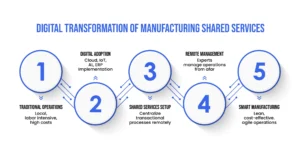
The solution wasn’t incremental cost-cutting. It was structural redesign (Deloitte).
| Category | Amount |
| Original annual finance & logistics cost | $1,311,000 |
| Role-based savings through realignment | $(645,560) |
| Offshore SSC investment (Expertise Accelerated) | $121,200 |
| Net payroll savings | $524,360 (40%) |
| Customer chargeback recoveries | $300,000 |
| Logistics deduction recoveries | $50,000 |
| AP discount capture (timely payments) | $80,000 |
| Total annual financial benefit | $954,360 |
The onshore team didn’t shrink, it sharpened. High performers were promoted. Strategic roles gained real bandwidth. The offshore team, specializing in CPG trade and deduction management, brought the kind of institutional knowledge the company had been struggling to hire domestically.
Payback period: under three months.
Despite the evidence, most mid-market manufacturing CFOs haven’t made resourcing strategy a formal annual priority. The reasons are understandable, the day-to-day pressure of running a finance function leaves little room for structural thinking. But the delay has a compounding cost.
The hidden costs of staying fully onshore include paying specialist rates for transactional work, losing skilled hires who see no meaningful professional horizon, fixed capacity that can’t absorb technology projects without burning out the team, recruiter fees of 20–40% on top of already inflated salary expectations, and six-month ramp times every time a role turns over.
A scaled offshore partner covering the transactional layer removes all five constraints at once. The onshore team gets better work, better pay, and better retention. The offshore partner in manufacturing accounting provides the redundancy and institutional knowledge that eliminates single-point-of-failure risk.
“When companies reduce cost on four or five out of ten team members, they can pay the remaining onshore staff better, give them more strategic work, and have more resources to invest in their development. It becomes a virtuous cycle.” Haroon Jafree, CEO, Expertise Accelerated
The infrastructure barrier is gone. The cost barrier is gone. The communication barrier, once a genuine friction point in distributed finance teams, has largely dissolved in a post-COVID world where async and video collaboration are just how work gets done.
What’s left is perception. There’s a lingering assumption that offshore means lower quality. For general-purpose outsourcing, that concern has some historical basis. But for a shared service center that specializes in a specific industry, one that has processed thousands of CPG or manufacturing transactions and actively advises clients on best practices, the quality argument runs the other way. A specialized SSC often knows more about industry-specific transaction processing than an onshore hire who’s new to the sector.
The practical advice for any manufacturing CFO considering the move: treat it like hiring. Interview the partner (Microsoft). Ask about your specific industry. Ask what they’ve seen across their client base. Hold their knowledge up against your own team’s. In most cases, the answer is clarifying.
Digital transformation in manufacturing is accelerating, not leveling off. ERP upgrades, AI-platform implementations, EDI expansions, and new automation rollouts are all on the near-term roadmap for most mid-market manufacturers, and every one of them requires bandwidth that fully onshore, fixed-capacity teams simply don’t have.
A shared service center gives you scalability that a headcount-based onshore model structurally can’t. Resources can be added or reallocated quickly. Project bandwidth can be created without bringing in consultants at U.S. market rates who’ll be redundant the moment the project wraps (Gartner). The offshore team, already embedded in your systems and workflows, can absorb the increased load while the onshore team stays focused on implementation, decisions, and strategy.
This is the inflection point most manufacturing finance leaders haven’t fully internalized: the choice isn’t offshore versus onshore. It’s between a scalable model and a fixed one, in an environment that will demand more flexibility, not less.
For manufacturing and CPG companies in the $20M–$100M revenue range, the shared service center question deserves a seat at the annual strategic table, not as a cost exercise, but as a talent strategy, a margin protection play, and an enabler of digital transformation projects that otherwise stall for lack of bandwidth.
The companies that made this move five years ago are operating with a structurally lower cost base, a more skilled and motivated onshore team, and a more resilient finance function. The gap between them and the companies that haven’t moved is only getting wider.
Expertise Accelerated works with manufacturing and CPG companies to design, implement, and operate shared service models built around your industry’s specific needs. The conversation starts with understanding what your current structure is actually costing you, in dollars, in talent, and in strategic capacity.
Ready to explore what a shared service model could mean for your business? Connect with Expertise Accelerated to talk through your current structure and what a transition could realistically deliver.