Planning & Analysis
Process Solutions


This blog explains how CPG tail spend gradually ruins margins invisibly, strategy-less and procurement-less.
At most CPG firms, leadership focuses on key suppliers and high-value deals. However, hundreds, and even thousands, of small, disconnected purchases pass through procurement across the entire organisation each month, with little control. On their own, they appear insignificant. When combined, they can constitute 10-20 per cent of expenditure. The margins in an industry as small as that are not background noise. It is profit slipping away.
Why is it a more important question than most leaders think?
The challenge in CPG tail management is not just how much money is being spent. It’s how scattered and complex the spending is.
In CPG (Consumer Packaged Goods) companies, “tail management” usually refers to managing the long tail of small vendors, low-volume SKUs, minor customers, or small-value transactions. This can include indirect materials, packaging materials purchased outside an agreement, marketing materials, one-off logistics, maintenance materials, and local vendor purchases to fix a short-term issue.
CPG tail management is not simply the amount spent. It is the fragmentation. The real issue is that the spending (or suppliers, SKUs, customers) is spread across too many small, disconnected pieces.
The characteristics of tail spend usually include unpredictable pricing, vendor duplication, lack of contract visibility, and manual approval processes. The cost of administration may exceed the purchase price. The relationships with the suppliers are not strategic. This gradually blows up costs that nobody will realise until margins become constrained.
And here is an uncomfortable question:
If 80 per cent of procurement activity focused on the 20 per cent of suppliers? What about the remaining 80 per cent?
The remaining 80% lacks organised analysis, consolidated negotiation, or alignment with the larger supply chain strategy in most CPG organisations. Industry statistics show that uncontrolled tail spend usually incurs 5-15 per cent more than required due to poor supplier consolidation and their leverage. It is a big difference in a business that operates with single-digit net margins.
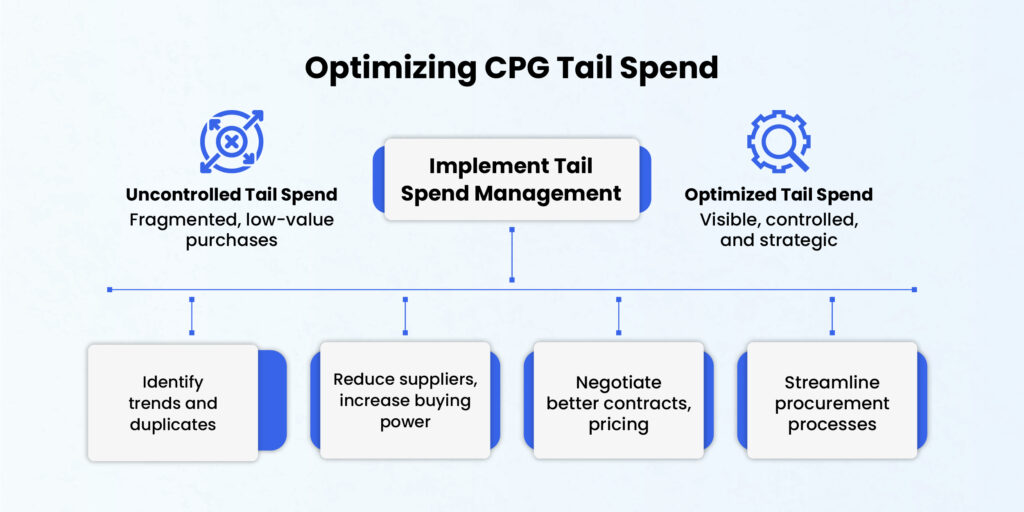
This is where CPG spend optimisation is directly related to profitability. At CPG, tail spend control is not about micromanaging small purchases. It is about visibility, identifying trends, focusing on suppliers, and synchronising procurement decisions with financial goals. When handled as part of the overall cost discipline, tail spend is a source of stability in the supply chain, minimising variability and building overall performance.
Tail spend management in the CPG industry is necessary as it is an effective level of procurement maturity. And in an industry where operational efficiency is the main determinant, even small figures should be taken seriously.
Defining CPG Tail Spend
CPG tail spend, in everyday financial activity, is minor, low value, and, frequently, decentralised purchases that are not considered as major negotiated contracts- consider incidental packaging, MRO or one-off vendor services. These purchases do not seem significant individually, but when combined, they go very quickly and are usually buried in spreadsheets rather than in strategy.
Strategic spend is controlled, keeping the supplier relations in mind; tail spend is responsive and uncontrolled. This can make it expensive. Harvard Business Review studies say that unmanaged tail spend can cut margins by up to 10-15 per cent due to a lack of leverage and unnecessary suppliers.
In a TEDx talk on how to optimise procurement, the professionals point out that the first step to controlling costs is visibility; otherwise, costs quietly drain each month.
In the absence of visibility into tail spend, businesses cannot see trends in duplicate vendors, irregular prices, or unnecessary purchases.
CPG companies usually handle thousands of SKUs across regions and channels. That breadth increases the number of small purchases required to sustain operations, and every single purchase is another uncontrollable spend slipping through the cracks.
Supplier diversity is resilient; however, unless it is disciplined, it disintegrates procurement. Having more than one supplier of similar products spreads purchasing power and lessens bargaining power, a topic discussed among supply chain managers at numerous industry conferences, such as APICS and SCM World webinars.
Many companies continue to use manual processes or outdated systems to track their spending in CPG spend optimization. As per the research Procurement Leaders referenced, companies with low spend analytics are overpaying by as much as 12 per cent because they lack enforcers of the negotiated terms or because concealed tail transactions are present.
Uncontrolled tail spend erodes cost control by increasing indirect costs, diverting procurement teams, and minimizing resources available for strategic sourcing. A lack of tail spend control in CPG can also lead to inaccurate forecasting and budgeting, creating a ripple effect throughout the P&L when finance leaders lack insight into spend.
Linking Tail Spend to Supply Chain Optimisation
Unmanaged tail spend presents uncertainty to the supply chain- there are many small suppliers, lead times are uncertain, and prices are uncertain- all these complicate planning. Experts at MIT Sloan’s supply chain stress that small, random buying is disrupting forecasting and inventory planning, making them slow to respond.
The strategic approach to procurement transforms reactive buying into disciplined sourcing, enhancing relationships with suppliers and minimising redundant orders.
Research in the industry reveals that companies with well-developed procurement plans perform better than their counterparts in cost management and supply reliability, which can be explained by the fact that including tail spend in procurement plans leads to a measurable reduction in overhead.
In shadow purchasing, managing tail spend in the CPG industry is not transparent. Technologies such as spend analytics software provide clarity, and industry experts such as Deloitte observe that procurement automation can reduce processing costs by up to 50 per cent and allow teams to focus on strategic decisions rather than data.
There are too many small suppliers, which is watering down buying power and increasing administrative costs. Consolidation of vendors also makes negotiation easier, as well as negotiating economies of scale through volume- a tactic that APICS webinars point out as an excellent way of saving costs in highly complex supply settings such as CPG.
Consolidated supplier set negotiations lead to superior contract performance, service, and pricing. Research by Procurement Leaders has shown that firms that centrally regulate tail spend through strategic sourcing achieve up to a 20 per cent cost reduction in indirect categories only.
Tail spend tends to mask irregular inventory as overstocking or stockouts. Good tail spend management ensures a better understanding of usage patterns, which will help manage stock levels more effectively and minimise waste. This advantage can be traced in the SCM World discussions by supply chain experts.
The right-tail solutions include spend analysis, category management, and automated workflows. These tools reduce unjustified expenditures when combined with procurement systems, but, more importantly, provide practical information that allows adjusting purchasing patterns to overall financial objectives and promotes sustainable CPG expansion.
Practical Tail Spend Reduction Techniques
The CPG requires that the first step in spend analysis be to clean and sort data at the plant, region, and department levels to identify underlying trends. Frequent findings of the McKinsey investigation state that, under conditions of data transparency, it is possible to unlock 5-10 per cent savings, exposing previously invisible redundant vendors and price discrepancies.
The current procurement tools concentrate the disjointed purchases in one place and impose category discipline throughout the organisation. The frequently reviewed and rationalised categories of spend make organisations less prone to maverick buying and enhance adherence to negotiated contracts, as discussed in various Gartner supply chain webinars.
Purchasing conducted manually and via email introduces delays and increases transaction costs. Digital procurement studies demonstrate that, through automating its processes, Deloitte can considerably lower processing costs, raise policy compliance rates, and convert tail spend into controlled processes rather than reactive ones.
Monitoring supplier KPIs, such as cost, delivery time, quality, and service levels, ensures that small vendors meet operational standards. Research by Harvard Business Review on supplier management has consistently shown that performance scorecards reduce unexpected cost escalation.
Unmonitored contracts tend to creep up in price and offer unfavourable renewal terms. Organised management of contracts, supported by electronic repositories and renewal warnings, can address losses through leakage and the assets of the negotiations over time.
Even the smaller suppliers affect operational stability. According to industry discourse on sites such as Supply Chain Now, the principle of a joint vendor relationship, based on transparency and collaborative forecasting, reduces disruption and improves the results of the negotiation process.
A sustainable tail spend strategy incorporates visibility, automation, supplier discipline, and executive control. As part of the broader procurement and supply chain strategy, tail spend management is not a cost-cutting practice but a long-term profitability protection for CPG companies.
What is CPG tail spend management? The trained art of recognising, managing and maximising the fragmented, low-value purchases that creep in and build up within a consumer packaged goods organisation.
Tail spend strategy is not just a way of cutting incidental costs. Orderly tail spend management eventually contributes to better margins, Supply chain improvement, increased operational focus, and business performance optimisation, all while maintaining profitability in an industry where accuracy is key.