Planning & Analysis
Process Solutions


Increase profit through effective operations and production cost control.
The production area was more active than ever. The machines were working, orders were coming in, and the sales team was reporting new contracts. On the surface, it was all a success story.
However, the increasing orders were hardly raising profits.
The reasons were not hard to find. Prices of raw materials had increased. Electricity charges were as high as ever. Skilled labour was getting more difficult to obtain. Production was slowly experiencing delays and unforeseen costs. There were supply chain disruptions. The factory was producing more output, but making less profit.
That is the dilemma most manufacturers experience today. The growth is rising without profitability. And it has made manufacturing cost reduction not only an operational matter but also a strategic one.
The shift is verified by industry research. According to Deloitte’s Global Manufacturing Outlook, cost management and operational efficiency remain the primary concerns among manufacturers amid inflation and supply chain fluctuations.
The lesson is becoming apparent in the industry. Better cost reduction is no only about minimising manufacturing costs through budget cuts or negotiating material prices. It also involves constructing smarter production systems, workflows, and processes to enhance operational visibility and improve efficiency. Let’s find out how.
Among the major conclusions that the readers will draw after reading the article:
The golden rule for achieving cost reductions in manufacturing is to drive operational improvements. They address inefficiencies that silently inflate production costs.
Experts often observe that most factories miss a huge opportunity due to downtime, workflow bottlenecks, and poor resource allocation.
The leaders on Manufacturing Happy Hour and The Manufacturing Executive Podcast have noted that improving production systems achieves faster savings. By reinforcing process efficiency and streamlining operations, manufacturers generate standard cost-of-production savings without compromising quality or production.
Intel shared that equipment downtime and process variability were slowing production during one of its chip manufacturing runs. The company optimized processes and minimized interruptions by applying real-time equipment performance monitoring through advanced analytics implementation and automation.
In that manner, Intel can enhance production efficiency and cut production costs without sacrificing quality.
Leaders in manufacturing place emphasis on the manufacturing process to reduce production costs. The debate in the industry centres on the potential of workflow redesign, digital monitoring, and smarter scheduling to enhance production efficiency and reduce operational delays.
Key approaches include:
The other strategy is the cost reduction of lean manufacturing, which emphasises eliminating non-value-adding activities. Lean models assist firms in achieving greater process efficiency and in reducing long-term factory costs.
According to research by Deloitte and McKinsey & Company, conducted in the industry, lean-oriented operations can substantially improve productivity and reduce operating costs. Manufacturers enhance manufacturing efficiency without sacrificing product quality through systematic waste reduction and workflow standardization.
Experts highlight that, in manufacturing cost management, technology is becoming the primary focus. Firms that are automating and investing in digital tools are experiencing quantifiable increases in productivity and performance rates.
Siemens has applied AI-based analytics and machine learning to optimise production and cost management at its Electronics Factory in Erlangen. With the help of AI-based defect detection and optimisation of the process, the company has attained:
The automation of manufacturing is a trend that has gained acceptance among manufacturers to enhance process efficiency and ensure a steady production level. Automated systems minimise manual errors, streamline production cycles, and enhance overall production efficiency across the factory floor.
The improvements include:
One of the highest operational costs is energy consumption; therefore, energy cost management is necessary to reduce long-term operating costs. The new factories are adopting digital monitoring systems to track energy consumption and streamline resource use.
Supply Chain and Procurement Strategies for Production Cost Savings.
Most manufacturers focus on factory efficiency, but opportunities for real reductions in manufacturing costs lie in procurement and supply chains. The sourcing of materials, supplier performance, and logistics planning could also significantly affect production cost reduction and operational stability.
McKinsey & Company industry research indicates that firms whose supply chains are optimised consistently rank highest in cost efficiency. As a result, supply chain strategy has become a primary cost-management aspect of the manufacturing process, not just a mere purchasing activity.
Supply chain optimization is becoming a popular tool for manufacturers to lower production costs by making better sourcing decisions and enhancing relationships with suppliers. Strategic procurement planning enables firms to stabilise material prices while ensuring a consistent supply of materials during production.
Professionals often observe that contemporary procurement is centered on cooperation rather than on price competition. Close collaboration and manufacturing cost analysis are based on data that help organizations achieve long-term supplier optimization and more stable manufacturing costs.
The other significant source of manufacturing cost optimization is smarter management of resources in materials and labor. The overall cost reduction in the factory may be achieved by selecting cost-effective materials and enhancing workforce productivity without impacting product quality.
Expertise Accelerated provides CPG and manufacturing firms with a hybrid onshore-offshore model. This involves a lean, well-paid team onshore, focused on decisions and oversight, and a specialized offshore team that is an expert in the manufacturing industry.
Onshore teams are lean, well-compensated teams focused on decision-making and transaction oversight. Offshore teams work as a specialized partner with the right experience in the manufacturing space.
Some of the benefits of a hybrid onshore-offshore model for manufacturing firms include:
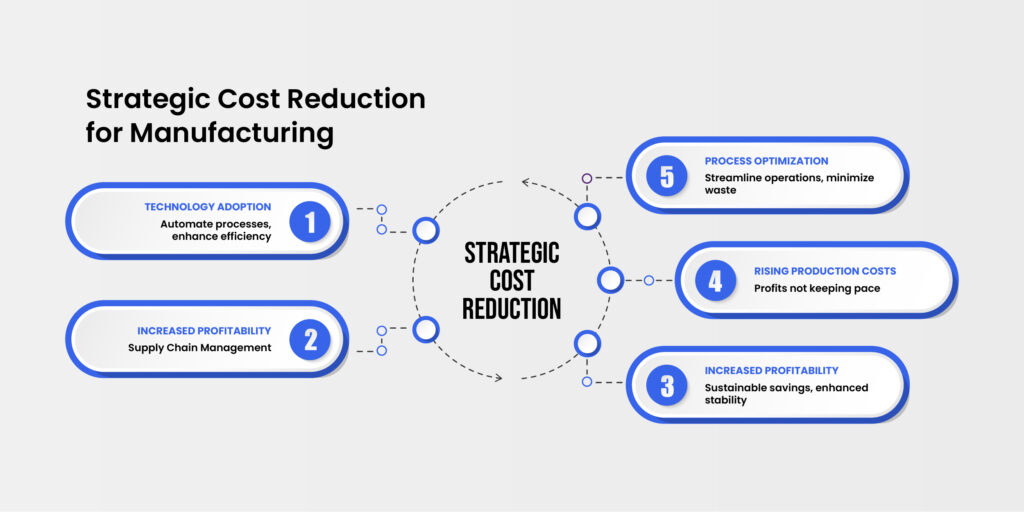
Besides optimising processes and adopting technology, manufacturers are also minimising costs through structural reorganisation, such as Shared Service Centres (SSCs), a hybrid delivery model, and selective outsourcing.
Outsourced teams can enable companies to standardise processes, minimise overhead, and enhance efficiency by centralising routine functions, such as accounting, procurement support, and reporting, within SSCs, without interfering with core operations.
One of the main trends noted by modern manufacturers is the reliance on digital tools and analytics to track performance and reduce manufacturing costs. Such systems provide real-time information on procurement, production, inventory, and supplier efficiency, enabling organisations to identify inefficiencies and make cost-effective decisions.
According to industry leaders, firms that are highly developed in analytics and software systems are more likely to enjoy increased profitability and operational stability. These applications provide more robust cost control in manufacturing through end-to-end visibility and actionable data. Some tools commonly used for benchmarking, supply chain planning, vendor performance tracking, and cost analysis are listed below.
Some software and platforms to support the cost performance include:
Such platforms facilitate various industry best practices for controlling costs, such as real-time cost analysis reports, comparisons with industry standards, automated procurement processes, and supplier performance management. Manufacturers that incorporate such systems into their operations can identify cost drivers, minimise waste, and align production and profitability objectives.
In a nutshell, the main message is that manufacturing cost reduction is no longer about cost reduction. It is a tactical science that integrates operational advancement, technology adoption, and supply chain intelligence.
To remain competitive in fast-changing markets, modern businesses are employing manufacturing cost strategies, lean manufacturing strategies, and cost management solutions.
Companies that invest in manufacturing optimization methods realize clear gains in production efficiency, enhanced financial stability, and sustainability.