 Skip to content




What if you could spot a shrinking profit margin or growing cash flow problem months before a project finishes?
WIP reporting in construction helps contractors identify these risks before they affect project profitability. By comparing committed costs, cost-to-complete estimates, billings, and percentage of completion progress, a work-in-progress report shows whether a job is profitable, overbilled, underbilled, or creating cash flow pressure.
Because revenue, costs, billings, and cash rarely move at the same pace, WIP reporting helps connect the dots between project performance and financial results.
This guide explains how WIP reports improve cash flow visibility, profitability tracking, and construction financial reporting.
The Construction Reporting Gap That WIP Reports Solve
Construction projects run for weeks, months, or years, and revenue, costs, billings, and cash rarely line up along the way. That timing gap is what a WIP report closes.
A standard income statement shows historical company performance but does not explain what is happening inside individual projects. It does not tell you whether the warehouse job is ahead of its billings or quietly losing margin.
A WIP report fills that space by tying project progress to actual and estimated costs, billings to date, revenue earned, and gross profit. From there, overbilling, underbilling, and cash flow risk all become visible on a single page.
What Is WIP Reporting in Construction?
WIP reporting in construction is the process of tracking active projects by comparing costs, estimated costs, billings, revenue earned, and percentage completion.
It turns scattered project data into one financial picture of where every job stands.
According to the AICPA’s guidance on construction WIP schedules, WIP reporting helps contractors monitor project progress, budget performance, and profitability throughout the life of a project, making it one of the most important reporting tools in construction accounting.
What a Construction WIP Report Shows
A construction WIP report lays out each active job across a consistent set of columns. Read together, they show whether the project is earning the profit it was bid to earn.
| WIP Report Column | What It Tells You |
|---|---|
| Contract value | Total revenue the job will bring, including approved change orders |
| Estimated total cost | What the job is expected to cost from start to finish |
| Cost incurred to date | What has been spent so far |
| Cost-to-complete | What remains to finish the work |
| Percent complete | Cost incurred divided by estimated total cost |
| Revenue earned | Contract value multiplied by percent complete |
| Billings to date | What has been invoiced |
| Over or underbilling | The gap between billings and revenue earned |
| Estimated gross profit | Adjusted contract value minus estimated total cost |
What WIP Reports Reveal That Financial Statements Miss
Financial statements show what has already happened. A WIP report shows what is happening inside active projects.
An income statement may show healthy profit for the month while a major project is quietly running over budget. Likewise, a balance sheet can show strong cash without revealing that a large portion came from overbilling.
WIP reporting bridges that gap by exposing project-level risks before they affect company-level financial results. It helps construction owners, controllers, and project managers spot margin erosion, billing issues, and cash flow pressure while there is still time to respond.
Need clearer WIP reporting for active projects?
Speak with a construction accounting expert.
Why WIP Reporting Is Different From a Basic Project Report
A basic project report focuses on timelines, tasks, and qualitative milestones, whereas, a WIP report serves as a precise financial tracking tool. It calculates the percentage of completion against actual costs to reveal earned revenue, overbillings, and underbilling.
Why WIP Reporting Matters for Cash Flow
WIP reporting matters for cash flow because it shows whether billing is keeping pace with the work performed and the costs already spent. When billing lags the work, cash goes out before it comes back in.
Construction cash flow tends to weaken when:
- Underbilling stays hidden for too long
- Costs are incurred before invoices go out
- Progress billing falls behind actual completion
- Retainage holds back a slice of every payment
- Change orders are performed but not billed on time
- Vendor and subcontractor payments come due before customer collections
Underbilling Creates Cash Pressure
Underbilling happens when earned revenue is higher than billings to date. The contractor has done the work but has not invoiced enough to match it.
This risk is one reason construction finance teams monitor underbillings closely. According to the CFMA’s construction financial health guidance, underbilling can significantly affect a contractor’s cash position and should be reviewed regularly as part of WIP reporting and project financial management.
A Simple Example of Underbilling
A project might look like this:
- Contract Value → $1,000,000
- Estimated Total Cost → $800,000
- Cost Incurred to Date → $400,000
- Percent Complete → 50%
- Revenue Earned → $500,000
- Billings to Date → $450,000
- Underbilling → $50,000
In this example, the contractor has completed enough work to earn $500,000 in revenue but has only billed $450,000.
The work has been performed, and the costs have already been incurred, yet $50,000 remains unbilled.
That gap often creates cash pressure because labor, materials, equipment, and subcontractor costs must still be paid while the billing catches up.
Overbilling Can Hide Future Risk
Overbilling is the reverse, where billings to date run ahead of earned revenue. It can feel like healthy cash flow, but it represents cash collected before the related work has been completed.
If costs keep coming and the billing room is already used up, the back end of the job turns tight.
Improve cash flow visibility by connecting WIP reporting, billing, AR, and AP.
Why WIP Reporting Matters for Project Profitability
WIP reporting matters for profitability because it surfaces margin changes while the job is still running, not after it closes. Mid-project is the only point where a slipping margin can still be corrected.
Margins move for plenty of reasons.
Labor or materials run over budget, subcontractor or equipment costs climb, a change order gets missed, the cost-to-complete estimate goes stale, or overhead lands on the wrong job.
A WIP report that updates with these changes shows the new expected profit before the surprise becomes permanent.
Cost-to-Complete Drives Profit Forecasts
A project’s expected profit is only as accurate as its cost-to-complete estimate. If the remaining labor, material, subcontractor, or equipment costs are understated, profitability can look stronger than it actually is.
On larger projects, even a small change in cost-to-complete can significantly affect projected gross margin. This is why WIP reviews focus so heavily on updating the remaining costs.
Accurate cost-to-complete estimates help construction companies identify margin pressure earlier, make better operational decisions, and avoid surprises at project closeout.
WIP reports reveal margin fade early by comparing original and revised estimates against actual costs and projected gross profit, helping teams catch profit erosion before it impacts the project.
The WIP Data Construction Finance Teams Need
A WIP report is only as good as the data behind it. Reliable reporting depends on both project information and accounting information being accurate and up to date.
Project Data
The project team supplies the information that determines progress and expected profitability, including:
- Contract amount
- Approved change orders
- Original estimated cost
- Revised estimated cost
- Actual cost to date
- Committed costs
- Cost-to-complete
These figures drive percent complete, earned revenue, and projected margin.
Accounting Data
Accounting provides the information that connects project performance to cash flow and financial reporting, including:
- Billings to date
- Retainage
- Cash collected
- Open accounts receivable
- Open accounts payable
When any one source lags, the WIP report drifts from reality, which is why accurate accounting and bookkeeping services keep those inputs clean enough to trust.
Common WIP Reporting Mistakes in Construction
Most WIP reporting problems trace back to a short list of habits. None are dramatic, which is why they go unnoticed until a job closes lower than expected.
- Updating cost-to-complete too late, which makes profit look steadier than it is
- Incorrect percentage of completion calculations.
- Leaving change orders off the report, which distorts contract value, billing, and projected profit
- Treating billings as profit, when profit depends on earned revenue and remaining cost
- Ignoring underbilling, which hides cash pressure and slow collections
- Ignoring overbilling, which masks shrinking billing capacity later in the job
- Feeding in miscoded job costs, where wrong labor, material, or subcontractor coding skews the whole report
- Building the WIP report without project managers, so the numbers never meet field reality
The last one does the most damage. A WIP report built only from the ledger misses what the people on site already know about where a job is heading.
How WIP Reporting Connects Job Costing, Billing, and Cash Flow
WIP reporting sits at the center of construction finance because it links what was built, what it cost, what was billed, and what was collected into one chain.
The flow looks like this:
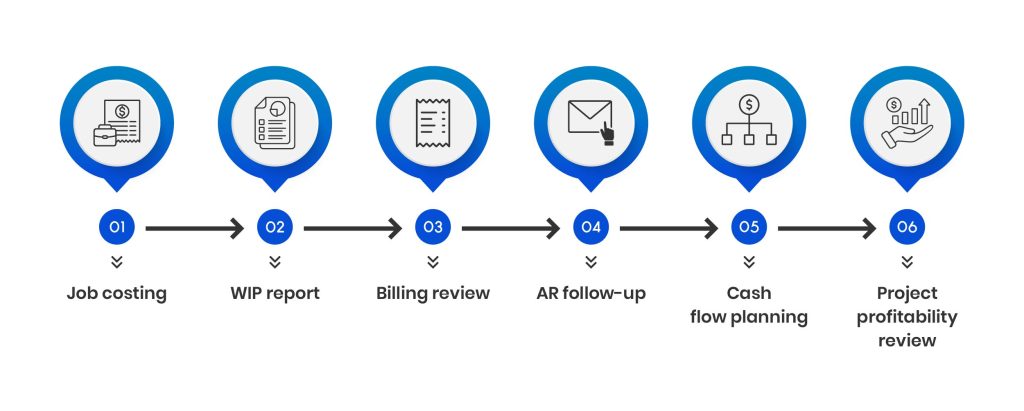
Job costing feeds accurate costs into the WIP report. The WIP report shows whether billing matches progress, which drives the billing review.
That review points AR follow-up at what to collect, collections feed cash flow planning, and the cycle ends in a profitability review that sharpens the next bid.
WIP Reporting and Accounts Receivable
WIP reporting supports accounts receivable by showing where billing has fallen behind the work, which is usually where collections are at risk too.
Read with an AR lens, a few lines of the report matter most:
- Billings to date against earned revenue
- Underbilling that signals unbilled work
- AR aging on what has already been invoiced
- Retainage waiting on project completion
- Open change orders not yet billed
- Collection status by customer
Aligning WIP data accounts receivable processes help convert billing visibility into faster collections.
WIP reports help prioritize collections. Not every unpaid invoice carries the same risk, underbilling paired with aging receivables signals which projects need collection attention now. Pairing WIP data with AR aging helps teams accelerate billing and ease cash flow pressure before it hits operations.
WIP Reporting and Accounts Payable
WIP reporting supports accounts payable because vendor bills, subcontractor payments, and committed costs all feed project cost, and their timing drives cash.
The report depends on open vendor bills, subcontractor payment schedules, purchase orders, and committed costs being captured and coded to the right job.
Watching AP aging and payment timing against the WIP picture shows when a wave of subcontractor payments will land before the matching billing is collected. Disciplined accounts payable services keep that cost and timing data accurate, which keeps the WIP report honest.
Delayed vendor invoices and subcontractor bills understate job costs, distorting profitability and percent complete. Accurate, on-time AP keeps costs in the right period so WIP reports reflect real project performance.
How Construction Companies Can Improve WIP Reporting
Improving WIP reporting comes down to better inputs and a steady review rhythm. The report gets sharper when job costs are clean, estimates are current, and the field and accounting read it together.
- Standardize cost codes and reconcile job costs before each WIP review
- Update cost-to-complete every month, not only at quarter-end
- Track both approved and pending change orders
- Review billings against project progress, separating overbilling from underbilling
- Review the WIP report with project managers, not accounting alone
- Connect WIP to AR and AP aging, and track retainage and collection status
- Feed WIP figures into forward cash planning
That last step is where the work pays off twice, since cash flow projections built on current WIP data give owners a forward view instead of a rear-view mirror.
Build a cleaner WIP reporting workflow for project profitability and cash planning.
When Construction Companies Need WIP Reporting Support
Construction companies usually need WIP reporting support when profitability, billing accuracy, cost-to-complete, and cash flow get hard to read at the same time. The early signs are quiet.
WIP reports show up late, cost-to-complete numbers go stale, and change orders keep missing the financial review. Project managers stop trusting the reports they are handed, and job costs no longer match what is happening on site.
The louder signs follow. Underbilling surfaces too late to fix, gross margin shifts with no clear cause, AR aging climbs while work continues, and cash flow surprises hit mid-project.
When the month-end close also drags, the WIP process has outgrown what the team can manage alone, and construction-focused construction accounting services can rebuild it.
How Expertise Accelerated Helps Construction Companies Improve WIP Reporting
Expertise Accelerated helps construction companies turn WIP reporting into something they can act on. Construction accounting is our specialty.
Our specialists help contractors build reliable WIP processes, from job cost cleanup and monthly reporting to AR/AP integration and profitability forecasting. That means cleaning up or rebuilding job cost data when it’s off, then keeping it current through monthly WIP reviews that update cost-to-complete and change orders and tie the schedule to AR, AP, and cash, so the numbers hold together.
Our experts work the way construction finance runs, reviewing the same figures as your project managers, so owners see project profitability and a clear cash position on every active job.
Book a consultation to improve WIP reporting, job costing, and construction financial visibility.
FAQs About WIP Reporting in Construction
What is WIP reporting in construction?
WIP reporting in construction is the process of tracking work in progress by comparing a project’s costs, estimated costs, billings, and revenue earned. The WIP report shows each active job’s percent complete, over or underbilling, and expected gross profit in one financial view.
WIP reporting is important because it shows whether projects are profitable, overbilled, or underbilled before the job closes. It connects job costing, billing, and cash flow, so owners and controllers can catch margin or cash problems while there is still time to act.
How does WIP reporting affect cash flow?
WIP reporting affects cash flow by showing whether billing keeps pace with work performed and costs incurred. When progress billing lags or underbilling builds up, cash leaves for labor, materials, and subcontractors before it comes back in from customers.
What is underbilling in a WIP report?
Underbilling means earned revenue is higher than billings to date, so the contractor has done more work than it has invoiced. It often signals cash pressure, because the costs behind that work are already being paid while the billing has not caught up.
What is overbilling in a WIP report?
Overbilling means billings to date exceed earned revenue, so the contractor has invoiced ahead of the work completed. It can support short-term cash flow, but it reduces billing room later and can leave the end of a project short if costs keep coming.
What data is needed for a construction WIP report?
A WIP report needs the contract amount, approved change orders, original and revised estimated cost, actual cost to date, committed costs, cost-to-complete, billings to date, retainage, cash collected, and open AR and AP. These come from the project team, the field, and accounting together.
When should a construction company get WIP reporting support?
A construction company should get WIP reporting support when reports arrive late, cost-to-complete is outdated, underbilling is caught too late, or gross margin shifts without explanation. Cash flow surprises during active projects and a slow month-end close are common signs the process needs help.
Talk to Expertise Accelerated about construction accounting support.
