Skip to content
Accounting
Audit
Planning & Analysis
Process Solutions
Operations



Find practical solutions to accounts payable problems in energy companies.
Accounts payable problems in energy companies are the breakdown of invoice control, approval workflows, and payment accuracy that happens when high vendor volumes, joint venture billing, and regulatory pressure hit a process that was never designed to handle any of it. When the process breaks, working capital drains, vendors get frustrated, and auditors find things nobody wants them to find.
A field services invoice arrives by email to an engineer sitting on a drilling site in West Texas. That same invoice shows up in the corporate AP inbox three days later. Both are recorded by two different accountants separately. Six weeks go by before anyone figures out what happened. That is a Tuesday at energy companies across the United States, and the dollar amount attached to it would surprise you.
This piece covers the eight AP problems that keep showing up at energy companies, a practical framework to fix them, and a checklist your team can work through this week.
Walk into the AP department of a mid-sized retail chain, and you will find a manageable vendor list, predictable invoice patterns, and standard payment terms across the board. Walk into the AP function of an oil and gas operator, and the picture looks nothing like that.
A single upstream company might juggle hundreds of field service vendors, equipment suppliers, chemical providers, and contract crews across multiple basins at the same time. Utility companies run separate AP streams for capital projects, grid maintenance, and regulatory spending simultaneously.
Renewables developers track invoices across project phases that shift by season and funding milestone. The sheer volume creates pressure that a standard AP process simply was not built to absorb.
Joint interest billing makes it harder. When two or more working interest owners split costs on a well, every invoice needs to be split, coded, and reconciled against the joint operating agreement before it goes anywhere. Get one cost allocation wrong and you are dealing with partner disputes for months.
Energy accounting services serving FERC-regulated utilities must maintain the kind of audit trails that federal examiners expect. Companies above the SOX threshold carry a legal obligation to document and test internal controls over financial reporting, and AP is where examiners spend a lot of their time.
Each of these pressures converts directly into AP risk, late payments, misclassified costs, and control gaps that surface during audits or partner disputes. GAAP accruals for unbilled field services add another wrinkle that a generalist AP team rarely handles correctly on the first pass.
Add multi-entity ledger routing and cash flows that swing hard by season and project phase, and a two-week payment delay at the wrong moment can strain liquidity across an entire quarter.
The people running AP at energy companies are not the problem. Running energy AP like a standard business is the problem.
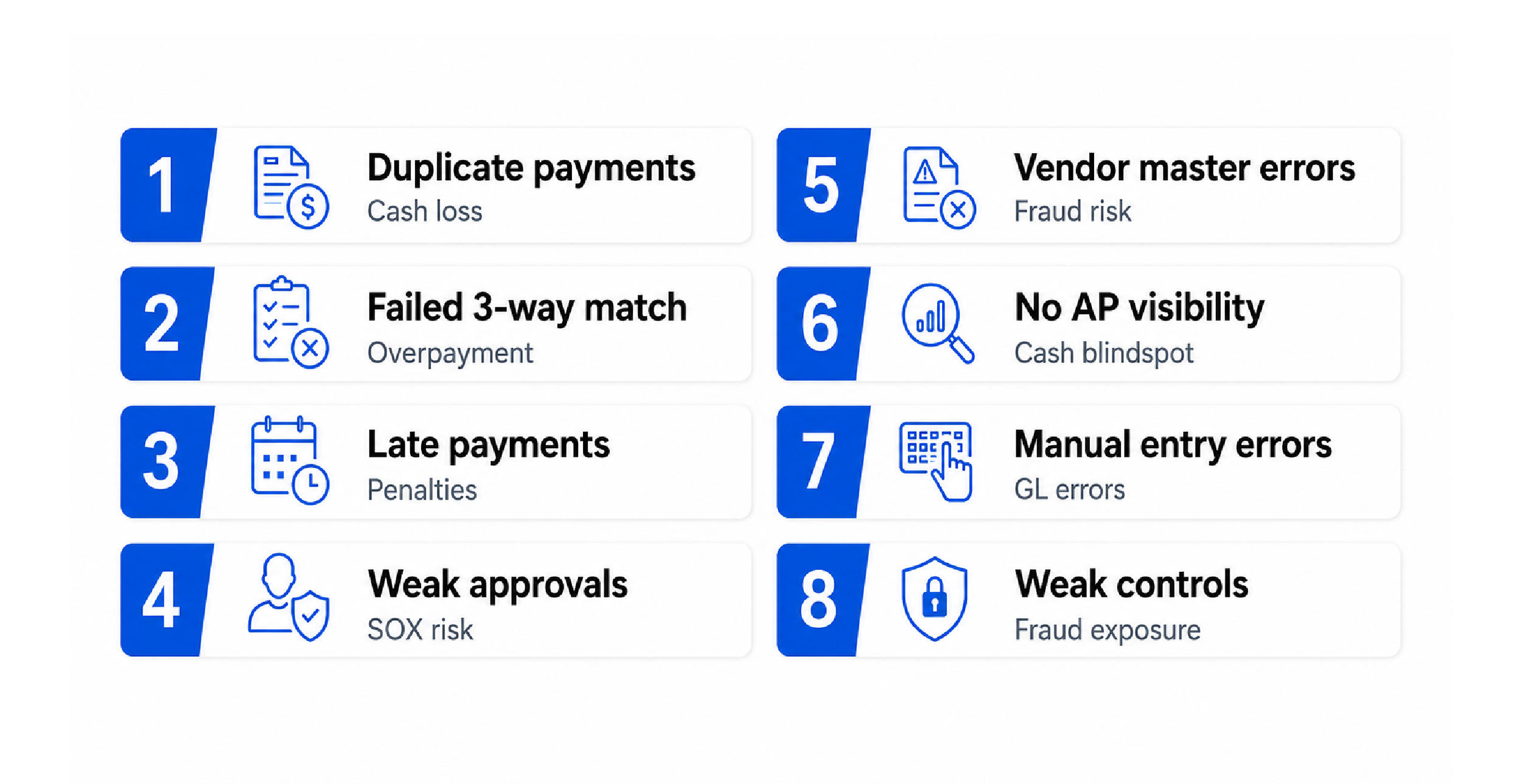
What are the most common accounts payable problems in the energy sector? They tend to cluster around the same eight failure points every time. Here they are, with the root cause behind each one.
No centralized invoice tracking means no collision detection. A field engineer gets an invoice from a drilling contractor. The same invoice hits the corporate AP inbox three days later. Both get entered. Both get paid.
According to Institute of Finance and Management research, duplicate payments run between 0.1% and 0.5% of total invoice volume at organizations without automated controls. Run the math on a company processing several million in vendor payments each month. Recovery means calling the vendor, chasing a credit memo, fixing the GL, and explaining to your controller why it happened again.
Match the purchase order to the goods receipt to the vendor invoice before you release payment. That is it. That is the whole control. When energy companies skip this step under schedule pressure, they pay for services not yet delivered, quantities that never arrived, or amounts nobody authorized.
Fast-moving field operations are where this slips most often. Someone feels the heat to get a contractor paid and the match gets waved through. That decision usually costs more than the invoice itself once you trace the downstream damage.
Manual AP workflows create approval jams. An invoice sits in an inbox for four days while an approver is out on a site visit. By the time the payment runs, the 2/10 net 30 discount window is gone and a late penalty has started ticking.
Ardent Partners research puts average invoice processing time at 10 to 14 days for organizations running manual AP. Energy companies working inside tight project budgets lose real money on both ends of that delay, once on the missed discount and again on the penalty.
Invoices routed to the wrong person. Verbal approvals with no documentation. No escalation path when an invoice exceeds someone’s authority. These three problems usually travel together.
Energy companies under SOX cannot afford undocumented approval chains. Auditors find them, boards want answers, and there are none. Get your approval workflow into the ERP with clear dollar thresholds and the problem goes away.
Your vendor master file runs every payment you make. Outdated banking details, duplicate vendor entries, vendors inactive for two years but still live in the system, all of these create problems that range from annoying to expensive. A misdirected ACH payment is hard and sometimes impossible to recover quickly.
A duplicate vendor record gives someone a blueprint for slipping a fraudulent invoice through a system that never flags it. APQC’s shared services benchmarking research calls out vendor master file management as one of the top recurring AP control gaps in mid-market companies. It shows up in audit after audit.
A CFO who cannot pull a real-time AP aging report is guessing at their cash position. When finance leadership cannot see what is owed, to whom, and when it comes due, month-end surprises become routine.
In energy, where large capex invoices and field service accruals move fast, one unrecorded liability can throw off financial statements and force a restatement. Accounts payable services that include live reporting dashboards close that gap and give leadership numbers they can actually manage by.
Wrong invoice amount, wrong GL code and/or wrong vendor matched to the payment. Any of those errors create downstream work that takes hours to unwind. In energy accounting, where lease operating expenses, drilling and development costs, and field services must hit the right accounts for both financial reporting and regulatory purposes, a single miscoded entry corrupts multiple reports at once.
Companies still running AP through spreadsheets have no safety net for this. Every payment run is a manual process with no error detection until someone finds the problem after the fact.
Segregation of duties. Approval authority limits. Payment run reviews. These are not recommendations. They are the floor for any company processing real AP volume. Energy companies above the SOX threshold have a legal obligation here.
Smaller operators below that threshold still face lender covenants, investor scrutiny, and basic fraud risk that demand the same discipline. A finance team where one person can enter, approve, and release a payment is a finance team waiting for something to go wrong.
| AP Problem | Root Cause | Business Impact |
|---|---|---|
| Duplicate Payments | No centralized invoice tracking | Cash loss, reconciliation cost |
| Failed Three-Way Match | No PO discipline | Overpayments, audit risk |
| Late Payments | Manual approval bottlenecks | Vendor penalties, lost discounts |
| Weak Approval Workflow | No AP SOP in place | SOX non-compliance, unauthorized spend |
| Vendor Master Inaccuracies | Infrequent master file audits | Misdirected payments, fraud risk |
| Poor AP Visibility | No AP aging dashboard | Cash flow forecasting errors |
| Manual Entry Errors | Spreadsheet-based AP process | GL errors, financial statement distortion |
| Missing Internal Controls | No segregation of duties | Fraud exposure, compliance risk |
How do energy companies control accounts payable? Not with one software purchase. Not with a new hire who gets overwhelmed in 60 days. You control AP by building the right process first and then backing it with the right tools. Here is how to do that.
Pick one intake channel and defend it. A dedicated AP email, a vendor portal, or direct ERP submission. Pick one. Engineers should not be receiving invoices on site. Managers should not be approving vendors by text. Paper invoices should not be sitting on desks waiting for someone to remember them.
Beyond intake, your GL coding rules need to be documented and shared with everyone who touches an invoice. LOE, D&D, field services, utilities, capital expenditures, every category defined, every code documented. One standard, applied the same way every time. The rework that comes from a miscoded invoice is always more expensive than the 30 minutes it takes to write the standard down.
Every invoice needs a matching approved purchase order and a confirmed receipt before payment goes anywhere. No shortcuts driven by schedule pressure. No “we’ll document it after.” If an invoice arrives without a PO, that is a procurement failure and it goes back through the right channel, not around it.
Write out your exception rules for recurring bills and blanket POs. Keep those exceptions narrow and deliberate. Any mismatch between invoice, PO, and receipt goes to a designated reviewer before the payment run touches it. The time you spend enforcing this is a small fraction of the time you spend recovering a wrong payment.
Document approval authority by dollar threshold, get it into your ERP, and hold the line. Three roles must exist and stay separate: invoice entry, invoice approval, payment execution. One person should never handle all three. That is not a best practice suggestion. For SOX-compliant energy companies, it is a requirement.
| Invoice Amount | Approver Level | Notes |
|---|---|---|
| Under $2,500 | AP Specialist | Routine vendor invoices |
| $2,500 to $10,000 | AP Manager | Standard field service invoices |
| $10,001 to $50,000 | Controller | Capital, project, or JV invoices |
| $50,001 to $250,000 | CFO | Major contracts, equipment, consulting |
| Over $250,000 | CEO / Board | Strategic or capital expenditures |
Set escalation rules so invoices sitting without action for 48 hours automatically send a follow-up. Most late payment problems trace back to an approval stuck in someone’s queue. This fixes that before it becomes a vendor call.
Full vendor master audit, at minimum once a year. Verify banking details before any payment goes out to a vendor, every time, through a documented onboarding process. Flag vendors with no activity in the past 12 months and deactivate them. Hunt down duplicate vendor entries and consolidate them.
Nobody enjoys this work. Do it anyway. A clean vendor master file means payments go where they are supposed to go. A dirty one means you find out something went wrong weeks after it happened, and recovery is never as clean as prevention.
What is the best way to manage AP in the energy sector? Measure it and look at the numbers every week, not once a month when month-end pressure hits. Finance teams that track AP metrics weekly catch cash problems weeks earlier than teams running monthly reviews.
| KPI | Definition | Target Benchmark |
|---|---|---|
| Days Payable Outstanding (DPO) | (AP Balance / COGS) x Days in Period | 30 to 45 days |
| Invoice Processing Time | Average days from receipt to payment | Under 5 business days |
| Invoice Error Rate | Errors divided by Total Invoices Processed | Under 1% |
| Duplicate Payment Rate | Duplicate payments divided by Total payments | Near zero (under 0.1%) |
| On-Time Payment Rate | Invoices paid on time divided by Total invoices | Over 95% |
| Early Payment Discount Capture | Discounts captured divided by Discounts available | Over 80% |
Pull the AP aging report every week. Review outstanding liabilities before your CFO has to ask about them. Monthly AP reporting to senior finance should cover aging by bucket, outstanding liabilities, and anything flagged for escalation. DPO is the number that tells you the most, fastest. Watch it monthly and understand what is moving it.
Invoice entry, approval, and payment execution should be assigned to three different people. No exceptions, no workarounds, no “we’re a small team” justifications. Fraud in AP almost always requires access to two of these three functions. The fix is to separate them structurally, not just on an org chart.
Quarterly AP reconciliation against the general ledger. Surprise AP audits at least once per quarter. Annual review of your internal controls and SOX compliance framework to make sure your controls still match your actual AP volume and headcount.
NetSuite, Sage Intacct, and QuickBooks all enforce the workflow rules at the configuration level and approval routing happens automatically. Three-way match exceptions get flagged before payment runs. Duplicate invoice detection runs on every submission without anyone having to remember to check. Energy companies already on one of these platforms often underuse them badly. The tool might already be there. It just needs to be set up.
For small-to-mid energy companies that cannot justify building out a full AP team, outsourcing gives you the controls, the ERP proficiency, and the sector knowledge of a complete team at a fraction of what hiring that team costs.
| Factor | Manual In-House AP | Outsourced AP Specialist Firm |
|---|---|---|
| Staffing Cost | Full FTE salary + benefits + overhead | 40 to 60% lower total cost |
| Error Rate | Higher due to manual processes | Lower through structured SOPs and review layers |
| AP Controls | Inconsistent without formal SOPs | Built-in controls, segregation of duties |
| Scalability | Hard to scale during project spikes | Flexible FTE or managed team |
| Industry Expertise | Depends on the individual hire | Energy accounting specialists from day one |
| Audit Readiness | Requires additional preparation | Always audit-ready, clean documentation |
| Software | Variable proficiency | QuickBooks, NetSuite, Sage Intacct certified |
Our CPA-led team builds AP controls for oil and gas, renewables, and utility companies, from three-way match enforcement to audit-ready documentation. Up to 60% cost savings versus hiring in-house. Book a Free AP Consultation
Go through this with your team. Every unchecked box is an open gap.
Most finance leaders know when their AP setup is not working. They just keep hoping it holds together until a better time to fix it. There is no better time. If your team is dealing with these situations, the cost of leaving things alone exceeds the cost of a solution.
Your invoice backlog runs 15 to 20 days or longer and never seems to clear. Month-end close keeps slipping because AP reconciliation is not done. Duplicate payments have shown up more than once in the past year. Nobody has documented how AP is supposed to run. An audit flagged AP approvals or segregation of duties as a finding. Your bookkeeper handles data entry, approval, and payment because there is nobody else.
Each of these is a problem on its own. Together they describe a finance function that is one bad month away from a serious incident.
Dedicated accounts payable services for energy companies and specialized energy accounting services are built for exactly this position. They provide full services with documented processes, ERP proficiency, and sector experience without the overhead of hiring and managing that team yourself.
Duplicate invoice payments, missing three-way match, late payments caused by manual approval jams, undocumented approval workflows, vendor master file problems, no real AP reporting, manual data entry errors, and missing internal controls.
These problems hit energy companies harder than most industries because the combination of high vendor volumes, JIB billing arrangements, multi-entity ledger structures, and FERC and SOX compliance requirements creates a level of AP complexity that manual processes cannot keep up with.
Start with a single invoice intake channel and enforce it. Build a three-way match into every payment run. Document approval authority by dollar threshold and route it through your ERP. Run a full vendor master audit and keep it clean. Track DPO, error rate, and on-time payment percentage every week.
Put three different people on entry, approval, and payment execution. Companies that automate these workflows through NetSuite, Sage Intacct, or QuickBooks run faster and with fewer errors than companies doing this manually. That gap is not small.
DPO is the time your company takes to pay vendors after receiving an invoice. Run the math: AP balance divided by cost of goods sold, multiplied by your days in the period. For energy companies, 30 to 45 days is where you want to land.
That window preserves working capital without damaging vendor relationships. A DPO sitting above 60 days usually points to approval bottlenecks or cash pressure. A DPO below 20 days usually means you are paying too early and missing the chance to put that cash to work or capture structured early payment discounts.
Automation handles at the system level what manual processes depend on people to remember. Approval routing goes to the right person automatically. Three-way match exceptions get flagged before payment runs, not discovered after.
Duplicate invoice detection runs on every submission. The Institute of Finance and Management reports that organizations using AP automation process invoices 73% faster and at significantly lower error rates than those running manual workflows. At energy-sector invoice volumes, that difference in error rate represents real reconciliation time and real dollars.
Professional AP support becomes useful when invoice backlogs reach 15 to 20 days on a regular basis. Month-end close delays, unfinished AP reconciliations, audit findings, and overextended bookkeepers also signal that the AP process needs stronger controls and dedicated ownership.
Outsourced AP typically delivers full-team controls, platform proficiency, and energy-sector knowledge at 40 to 60% lower cost than building that capability in-house. For small-to-mid energy companies, that math is usually not close.
Energy companies do not struggle with AP because teams lack effort. They struggle because the process lacks structure. Duplicate payments, failed three-way matches, weak approval chains, and manual entry errors keep recurring when AP workflows are not built for energy operations. A stronger AP process can fix that.
One invoice intake channel, no exceptions. Three-way match before every payment run. Approval tiers documented in the ERP. Vendor master audited, not glanced at. Someone is pulling AP numbers every week. Entry, approval, and payment go to three different people, then decide whether automation or outsourcing fits your budget better.
Your AP function should protect your cash, keep your auditors satisfied, and keep your vendors from calling. If it is doing the opposite right now, that is not bad luck. It is a process gap, and process gaps close faster than most people expect once someone decides to close them.
Our CPA-led team works with U.S. oil and gas, renewables, and utility companies to fix AP problems at the root, from vendor invoice management and three-way match enforcement to month-end accuracy and audit-ready documentation. Up to 60% cost savings versus building in-house. Book a Free AP Consultation.