Planning & Analysis
Process Solutions


That is MRO inventory management failing in real time. And the worst part? It happens every single day in operations that treat maintenance supplies as a second-tier problem.
A $12 bearing shut down an entire factory floor. Not a power cut. Not a strike. One $12 bearing ran dry, the line stopped, and losses stacked by the hour while someone scrambled to find a replacement that should have been on the shelf three weeks earlier.
That is MRO inventory management failing in real time. And the worst part? It happens every single day in operations that treat maintenance supplies as a second-tier problem.
MRO, maintenance, repair, and operations, runs between 5 and 10% of the cost of goods sold. Boston Consulting Group puts it as high as 4.5% of total revenue in some industries. For a line item that size, most companies manage it like a footnote: no reorder logic, multiple departments buying the same part from different suppliers, emergency freight bills nobody budgeted for, and a $250,000 saving sitting untouched on the P&L.
This guide covers what MRO inventory management actually is, where the money bleeds out, and what getting it right looks like, financially and operationally. Our inventory management services help operations teams build exactly these systems.
Your key takeaways: defining and classifying MRO stock, understanding the source of financial drain, maintenance strategies to reduce inventory chaos, and the best practices and software options for businesses at different scales.
Most operations managers cannot answer this cleanly. Ask them on the spot, and you get a pause, a guess, and three different answers depending on who you ask next.
MRO inventory is every supply, tool, spare part, and consumable that keeps production running without ever touching the finished product. The oil in your machines. The gloves on your workers’ hands. The spare motor on the shelf. None of it ships to the customer. All of it is what makes shipping to the customer possible.
The list is wider than most teams realize. Maintenance items, lubricants, bearings, motors, valves, and cutting fluids. Safety and PPE, hard hats, respirators, gloves, face shields. Facility supplies, cleaning products, HVAC filters, and lighting. Office and tech consumables. Chemicals, coolants, hydraulic fluids.
All of it MRO. All of it is usually managed by nobody in particular. That is the problem.
The complexity comes from the fact that MRO touches almost every department, and procurement, operations, and facilities rarely coordinate. Without inventory synchronization across departments, each team flies on partial data. The gaps show up as duplicate purchases and stockouts at the same time, in the same building.
Direct inventory vs. MRO inventory: the distinction matters financially too. Direct materials go into the product and connect to revenue. Every unit consumed links to a unit sold, so it gets tracked tightly. MRO does not link to revenue, which is exactly why it gets treated as a second-tier problem. That is the logic that turns a $12 bearing into a five-figure downtime event.
Nobody thinks MRO is their problem. Procurement assumes operations track it. Operations assumes facilities handle it. Facilities assume procurement ordered it. The part runs out. The line stops. The customer learns before the buyer does. Here is exactly where that drain appears.
Unplanned downtime is the visible one. One stockout on a critical spare part stops a production line cold. In heavy manufacturing, that is thousands of dollars per hour, not per day, per hour. In most cases, the part existed somewhere in the building. Nobody tracked that it was running low.
Dead stock eating working capital is the quiet one. Overstocking MRO runs 20 to 30% above actual need in most operations, according to industry benchmarks. Those parts sit on shelves carrying holding costs, storage, insurance, and tied-up capital, while cash does nothing useful. To understand how overstocked MRO hits your cash flow and working capital directly, see how inventory management drives customer satisfaction and the downstream effects it creates.
Maverick buying is the expensive habit nobody names. Without centralized purchasing, departments buy the same items separately, from different suppliers, at different prices. Someone runs short, panics, and pays rush freight. That pattern repeats monthly, quarter after quarter, and shows up as bloated operating expenses nobody can explain at the line level.
Compliance gaps are the ones with legal consequences. Running out of PPE is not just an operations problem. OSHA does not accept “our system did not flag it” as an answer, and no business wants to learn that in the middle of an inspection.
| MRO Category | Avg. % of COGS | Risk If Unmanaged | Management Strategy |
|---|---|---|---|
| Spare Parts & Equipment | 2–3% | Production downtime | Predictive maintenance + ERP integration |
| Safety & PPE | 0.5–1% | OSHA violations | Reorder point automation |
| Janitorial & Facility | 0.3–0.8% | Facility degradation | Scheduled procurement cycles |
| Office & Tech Supplies | 0.5–1.2% | Admin bottlenecks | Centralized PO management |
| Lubricants & Chemicals | 0.4–1% | Machine failure | Just-in-time replenishment |
| Total MRO Spend | 5–10% of COGS | Billions in global losses | Integrated MRO system |
Source: Boston Consulting Group; Intuit; RS Components
Maintenance is proactive work: lubricating machines on schedule, replacing filters before they fail, running diagnostic checks before problems show up on the P&L. Think of it like an oil change. You follow the schedule because waiting for the engine to seize costs far more than any service interval ever does.
Repair defines how fast you recover when something breaks. Speed depends almost entirely on whether the right part is already on the shelf. That is why inventory management and repair planning are not separate conversations; they are the same one.
Operations is everything else: office supplies, cleaning materials, safety gear, and technology consumables. Unglamorous. Completely load-bearing.
All three compete for warehouse space, budget, and attention. The right inventory management system is what makes that balance achievable. Without it, one of the three always gets neglected, and the cost shows up somewhere on your income statement.
The maintenance strategy you choose is, in effect, your inventory strategy. This matters more than most teams realize.
Corrective maintenance fixes things after they fail. Reactive by design. For low-criticality equipment it is acceptable. For anything production-critical, it means unpredictable downtime and completely chaotic inventory demand. You cannot plan for a failure you did not see coming.
Preventive maintenance works on a schedule. Replace components before they break, based on time or usage indicators. Procurement gets lead time. Rush orders become the exception, not the rule. This is where inventory management starts returning real value.
Predictive maintenance uses sensors and real-time monitoring to catch problems before they become failures. When you can see a bearing degrading before it fails, you order the replacement at the right moment, not in a panic afterward. Waste drops. Downtime drops. And your MRO stock levels reflect reality instead of guesswork.
Most mature operations combine all three, based on equipment criticality and the cost of failure. The discipline here mirrors what practical inventory controls look like in high-velocity environments; check out this restaurant inventory management guide to understand the concept better.
Studies consistently put downtime reduction from tighter MRO control at around 20%. For a production operation running on thin margins, that number goes straight to the bottom line.
The cost math changes across the board. Right stock levels at the right location at the right time means less emergency purchasing, fewer rush freight bills, and supplier terms negotiated from a position of real, consolidated volume. A 10% reduction in MRO spend at a company running $50M in COGS returns $250,000 to the business annually. That is not a projection; that is arithmetic.
Supplier relationships shift when you have data. Telling a supplier you are moving $200,000 a year through them is a different conversation than placing scattered orders and hoping for good pricing. Full spend visibility is negotiating leverage. Without it, you are guessing, and suppliers know it.
For operations teams connecting MRO cost modeling to broader financial planning, the relationship between demand planning and inventory stocking levels is direct. Our breakdown of demand and supply planning shows how that alignment works in practice.
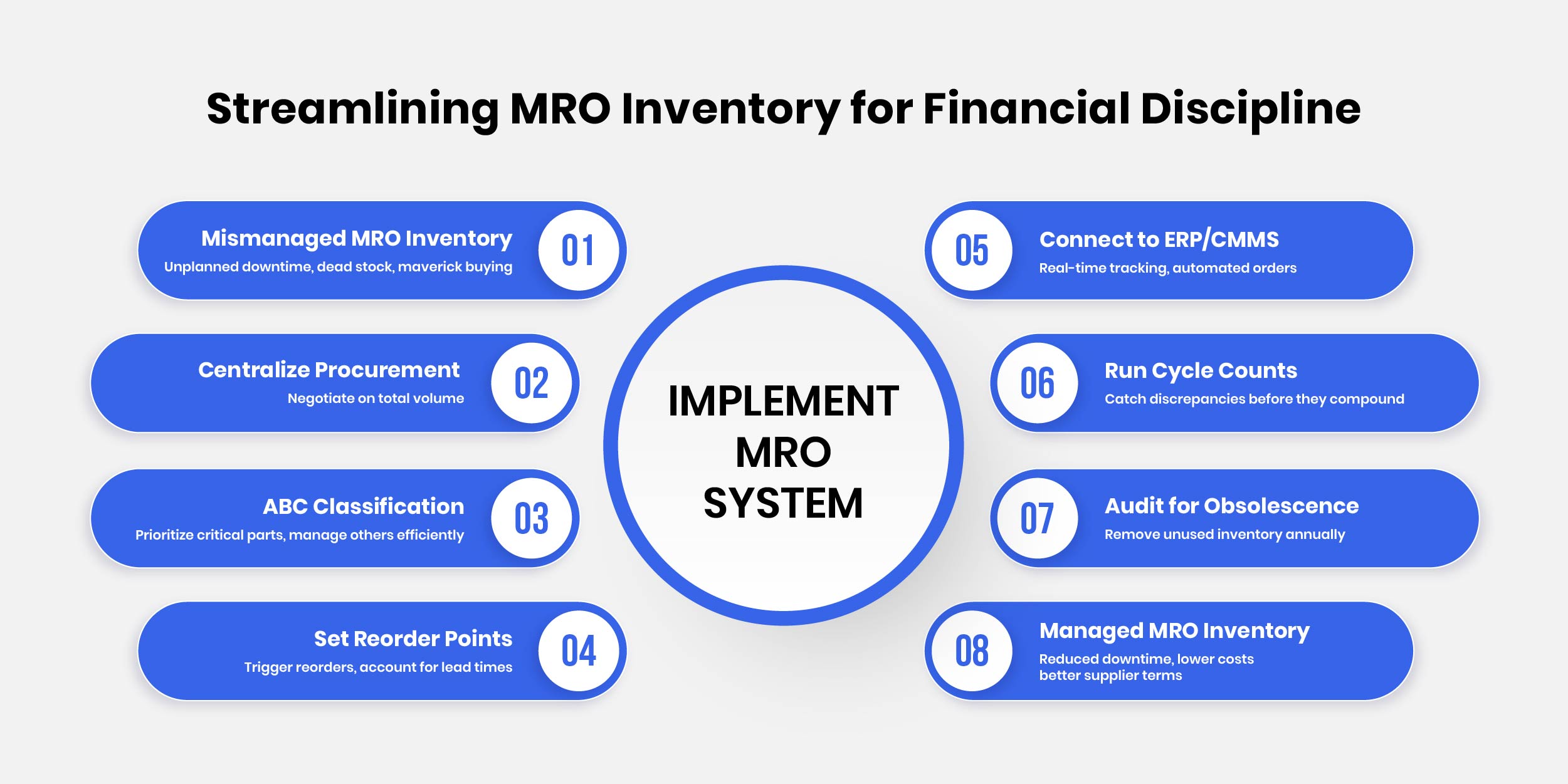
Centralize procurement first. Pull purchasing together, negotiate on total volume, and stop paying fragmented prices. Start with the highest-frequency items; that is where savings appear fastest.
Use ABC classification and let it drive decisions. Production-critical parts get tight controls, defined reorder points, and backup suppliers. Shop rags do not need the same treatment. Managing both identically wastes resources in both directions.
Set reorder points and safety stock, then revisit them annually. Every item needs a floor that triggers a reorder and a buffer that accounts for lead times and demand spikes. Equipment aging changes failure patterns; numbers set once stop being accurate within two to three years.
Connect to your ERP or CMMS. Real-time stock tracking, automated purchase orders, and maintenance schedules tied directly to procurement: that is what a properly integrated system delivers across multi-system inventory management. Nothing falls through because of a missed manual entry. Connecting financial planning and analysis to MRO data gives the finance team an accurate operational cost picture rather than estimates.
Run cycle counts, not just annual physicals. Rotating through stock continuously catches discrepancies before they compound. Small problems stay small when you find them monthly. They become expensive ones when you discover them in a year-end audit.
Audit for obsolescence once a year. Parts get discontinued. Equipment gets retired. If nobody watches for it, shelves fill up with inventory for machines you stopped running three years ago. That is not a storage problem; it is a write-off waiting to happen.
Spreadsheets have a volume ceiling. Most operations running at scale have already hit it. Cloud-based MRO management platforms have made it far more practical for mid-sized businesses to get real-time control without the implementation cost that enterprise systems used to require. Here is what the platform landscape actually looks like and which tool fits which business type.
| Platform | Best For | Key Strengths |
|---|---|---|
| IBM Maximo | Large enterprise, asset-heavy industries | Full ERP integration, asset lifecycle management |
| SAP Plant Maintenance | SAP-integrated enterprises | Native SAP ecosystem, deep reporting |
| Oracle EAM | Enterprise operations on Oracle | End-to-end asset management, strong analytics |
| eMaint CMMS | Mid-to-large operations | Configurable workflows, strong maintenance scheduling |
| Katana MRP | Mid-market manufacturers | Affordable, fast to implement, clean UX |
| Limble CMMS | Small to mid-sized operations | Easy to use, strong mobile access |
For a broader look at how these platforms fit into wider operations management, NetSuite’s MRO inventory overview is a useful reference point.
Before evaluating features, ask three questions: Does it connect to your existing ERP? Does it automate purchase orders without manual stock checks? Does it give your finance team clean data for cost allocation? If the answer to any of those is no, it is not solving the real problem.
The bearing replenishment cycle that ran without a single emergency order all year never makes the highlight reel. Nobody celebrates it. But the line that never stopped, the shipment that went out on time, the audit that found nothing wrong: that is what good MRO inventory management produces, quietly, quarter after quarter.
Every dollar lost to MRO waste is a dollar that never reached the bottom line. The businesses that get this right share one common thread: they treat maintenance supply management as a financial discipline, not an operations afterthought.
Start with three questions: what do you have, where is it, and what does it cost to carry? Build the reorder logic. Set the safety stock. Consolidate the suppliers. Scalable MRO solutions grow from those three disciplines, not from buying software first.
Ready to get MRO inventory under control? Expertise Accelerated works with operations and finance teams to build the inventory systems, financial controls, and reporting structures that turn maintenance spend into a managed cost line. Talk to our team to see what that looks like for your business.
It is the process of tracking, controlling, and optimizing the maintenance, repair, and operations supplies that keep a business running without becoming part of the finished product. The goal is the right items, at the right time, at the right cost, without tying up excess capital in slow-moving stock.
From bearings, motors, valves, lubricants, hydraulic fluids, to Hard hats, respirators, and safety gloves. HVAC filters, cleaning products, lightbulbs and office consumables are all included. None of it reaches the customer, but pull any of it, and the operation stops. Keeps the business running, but never goes into the finished product? That is MRO.
One $12 part can stop a line running at $50,000 an hour. Happens regularly in facilities that treat MRO as an afterthought. Manufacturing runs on equipment uptime. Uptime runs on having the right parts there when they are needed.
MRO sits at 5 to 10% of COGS, too, so it is a real budget line, not a rounding error. Leave it unmanaged and costs pile up in three places: dead stock on shelves, emergency freight on orders that should have been routine, and maverick buying from teams that ran out and had nowhere else to go.
Two ways. Both hurt. Overstocking is the first problem. Most operations hold 20 to 30% more MRO than they use. That stock sits on shelves with storage costs, insurance, and tied-up capital attached to it.
Understocking is the second, pushing teams into emergency purchases at rush freight rates, often for parts that a regular supplier had at half the price. Get the stock level right, and both problems go away. Working capital frees up without changing anything else.
Pull procurement together first. Fragmented buying across departments means different prices for the same item, sometimes from the same supplier. Centralize that, then apply the ABC classification. High-criticality parts get tight controls.
Low-value consumables do not need the same attention. Set reorder points for every item, check them once a year, because equipment ages and the numbers shift. Monthly cycle counts beat waiting for the annual physical every time. A business at $50M COGS, cutting MRO spend by 10,% puts $250,000 back on the bottom line. The math is not the hard part. Sticking to the process is.
Inventory turnover rate, stockout frequency, carrying cost as a percentage of inventory value, emergency purchase rate, MRO spend as a percentage of COGS, supplier on-time delivery rate, and obsolete stock percentage.
Direct inventory goes into the product and ties directly to revenue. MRO keeps production running, but never reaches the customer’s hands. Because MRO does not link directly to revenue, it gets under-managed, which is why the financial impact of mismanaging it is so easy to miss until it compounds.
Reorder Point = (Average Daily Usage x Supplier Lead Time in Days) + Safety Stock. Revisit these numbers annually, because equipment aging changes failure patterns and numbers set once stop being accurate.
IBM Maximo, SAP Plant Maintenance, Oracle EAM, eMaint, and Infor EAM for enterprise operations. Katana MRP and Limble CMMS for mid-market businesses that need faster implementation and lower entry cost.
Start with consistent expense classification: which MRO costs get expensed as period costs versus capitalized. Integrate MRO data with the general ledger. Reconcile physical stock counts against recorded inventory monthly. Run annual obsolescence audits. Document reorder logic and procurement controls for audit readiness.