Skip to content
Accounting
Audit
Planning & Analysis
Process Solutions
Operations



Unapplied cash is more common and damaging than business owners realise.
The Fix Most Finance Teams Overlook
Imagine your customer pays. The money lands in your bank account. And yet, your AR aging report still shows that invoice as open. Your DSO looks worse than it is. Your controller is asking questions you can’t confidently answer. And somewhere in a suspense account, cash that legally belongs to you is just sitting there doing absolutely nothing.
Unapplied cash is more common and damaging than business owners realise.
Key Takeaways
Before we get into the how, here is the short version for you:
Picture this. A customer wires $18,400 into your account on a Tuesday afternoon. Your bookkeeper sees it land, logs it and then stares at the screen. The remittance detail says nothing useful. Or the customer bundled three separate invoices into one tidy number without telling anyone. Maybe the invoice hadn’t even been posted yet when the payment came flying in.
So the money sits. Logged, yes. Applied? Absolutely not.
That right there is unapplied credit, and it is far more common than most finance teams want to admit.
That $18,400 sits in a suspense account. Unapplied. Your AR still shows the original invoices as outstanding. Your collections team may send a follow-up to that same customer asking for payment that has already been made. The customer gets frustrated. Your team wastes time investigating. And if this plays out across hundreds of accounts, which it does, in most mid-size businesses, you have a serious working capital problem dressed up as an accounting nuisance.
Unapplied credit in accounting can arise from several situations: customer overpayments, advance payments made before an invoice is issued, credit memos that were never properly applied, duplicate payments, and simple remittance matching failures. It is a credit not yet assigned to a specific invoice or account balance, money received, but not yet doing its job in your books.
The challenge is that these credits do not stay isolated. They compound.
Here is where businesses underestimate how bad this gets.
According to Blackline’s B2B AR benchmarking data , businesses relying on manual AR processes have 30% longer average DSO than those using automation. Only 23% of businesses have any form of cash application automation in place. And 52% of finance leaders identify too many manual processes as the single biggest weakness in their AR function.
That is a lot of businesses sitting on unapplied cash and wondering why their cash flow feels tighter than the revenue numbers suggest.
Let’s look at what unapplied credit actually does to your financials and operations:
| Impact Area | What Happens | Business Consequence |
|---|---|---|
| AR Balance | Open invoices remain outstanding despite the payment received | Overstated receivables, distorted aging report |
| DSO | Payments not posted = collection cycle appears longer | Higher DSO, weaker working capital metrics |
| Cash Flow Visibility | True available cash is hidden in suspense accounts | Poor forecasting, reactive decision-making |
| Collections Activity | Team chases invoices already paid | Customer frustration, wasted staff time |
| Month-End Close | Reconciliation is slow and incomplete | Delayed reporting, pressure on finance team |
| Audit Readiness | Payments not matched = unexplained credit balances | Flags for auditors, increased scrutiny |
| Revenue Recognition | Cash basis accounts may misrepresent income | Compliance risk, inaccurate reporting |
Each one of these is a real problem. Together, they can quietly erode the financial clarity a growing business needs to make sound decisions. If your controller cannot give you a clean answer to “what is our actual cash position right now?”, unapplied credit is probably part of the reason.
The honest answer? Most AR teams are managing more volume than their processes were designed for.
Bectran’s year-end AR research puts it plainly: even a well-configured cash application system with an 80% auto-match rate still leaves 20% of payments requiring manual intervention. For a business processing 10,000 payments a month, that is 2,000 manual reconciliations. When transaction volume doubles, the exceptions double with it, and the team does not.
The most common causes of unapplied credit include:
Missing or incomplete remittance information. A customer sends an ACH transfer without a clear reference to the invoice it covers. Without that link, the payment cannot be automatically matched, it waits for a human to figure it out. And if that human has 200 other payments to process, it waits a while.
Customer overpayments. A buyer rounds up, pays from a different entity than expected, or simply does not account for a credit memo they were owed. The extra amount sits unapplied until someone contacts the customer or issues a refund.
Advance payments. Cash arrives before the invoice is posted. The payment has nowhere to land, so it parks itself in suspense until the books catch up.
Bundled payments. One wire covers invoices across multiple branches, multiple time periods, or multiple line items. Parsing that without structured remittance data is detective work, not accounting.
Data entry errors. The wrong account number, a transposed invoice reference, a typo in the amount, any of these can send a payment to the wrong place or leave it floating.
Understanding which of these causes drives most of your unapplied cash volume is the first step to fixing it. Audit your unapplied credit aging report right now; if you see the same customers appearing repeatedly, that is not random. That is a systemic issue.
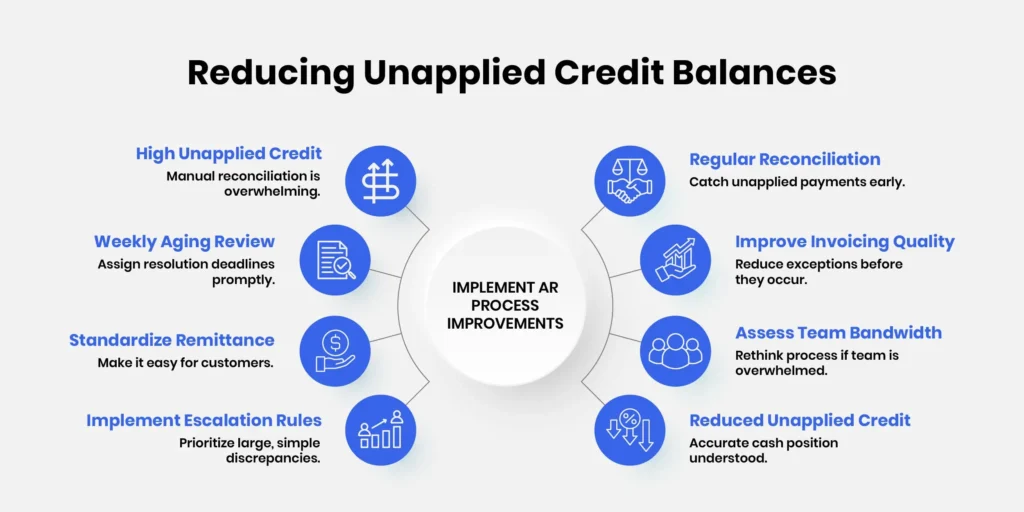
Here is where most articles give you a generic checklist. We will be more specific than that, because the right fix depends on the scale and root cause of your problem.
Every payment that stays unmatched for more than 48 hours should be assigned to someone with a clear deadline to resolve it. Unapplied cash treated as a “we’ll get to it” task grows into a month-end crisis. Create a standing agenda item, track the total unapplied balance week over week, and treat a rising balance as an early warning signal.
You cannot control how every customer pays, but you can make it easier for them to send you what you need. A simple remittance template, a customer payment portal, or even a standard email format with “Invoice # / Amount” can eliminate the guesswork that causes most unmatched payments. The cleaner the remittance data coming in, the fewer exceptions your team has to chase.
Not all unapplied cash is equal. Segment your unapplied credit queue by value and complexity; large, simple discrepancies should be resolved first, since clearing them has the most immediate impact on DSO and cash visibility. Small variances under a defined threshold should have a defined write-off or adjustment policy so they do not accumulate into a long tail of noise that blocks your reconciliation.
This sounds obvious. It is less commonly done than it should be. Regular, structured reconciliation between your bank statements and your AR ledger is how you catch unapplied payments before they age into a problem. This is a core component of solid general accounting and bookkeeping services ,and if your current process does not include it as a non-negotiable, that is worth examining.
Unapplied credit is often a symptom of upstream invoicing problems. Invoices with unclear reference numbers, multiple line items that customers consolidate, or terms that customers interpret differently than you intended ,all of these produce payment behavior that is hard to match. Clean invoicing reduces exceptions before they are created.
This is the uncomfortable question. Industry research from Emagia shows that organizations without cash application automation spend up to 70% of their AR team’s time on manual tasks . If your AR team is drowning in exceptions, the solution is not to push harder ,it is to rethink the process. A review of your outsourced finance services vs in-house teams may reveal a faster, leaner path to AR accuracy than hiring additional headcount.
There is a version of this problem that no process tweak will fix. If your business has scaled, your payment volumes have grown, your customer base is complex, and your AR team is still running on the same manual workflows from three years ago , you are not dealing with a cash application problem. You are dealing with a capacity and infrastructure problem.
The signs it’s time to outsource accounting services often show up in the AR function first. Mounting unapplied credit balances. Aging reports that your leadership team cannot trust. Month-end closes that keep slipping. Collections activity that is reactive instead of strategic.
In short, accurate cash application is the foundation that makes both work. Without it, you cannot trust the income statement, the balance sheet, or the cash flow statement.
One example worth noting: Kapittx’s case study research documented a company that reduced its unapplied cash balance from $2 million down to $400,000 within six months ,not by hiring more staff, but by restructuring its cash application process and introducing automation. That is not a marginal improvement. That is working capital that was locked up in a suspense account and brought back into operational use.
A Fractional CFO can also play a critical role here ,not just in reviewing the balance sheet, but in diagnosing the AR process gaps that are creating cash visibility problems in the first place. If leadership is making decisions on cash flow forecasts they cannot fully trust, that is a CFO-level problem, not just an AR-team problem.
Unapplied cash is not a back-office quirk. It is a window into how well your AR process is actually functioning ,and how accurately your business understands its own cash position.
The fix requires consistency, the right internal controls, and an honest look at whether your current team and process are built for the volume and complexity your business now operates at.
Weekly aging reviews. Standardized remittance. Clear escalation rules. Proper reconciliation. And the willingness to ask whether your AR function needs to evolve.
If you are looking at an unapplied credit balance that keeps growing no matter what your team does, the conversation you need to have is about the people and processes running it.
Expertise Accelerated works with businesses at exactly this inflection point ,where the books are technically maintained but the financial picture is blurry, and leadership knows it. Our CPA-led AR teams bring the process discipline, the reconciliation depth, and the reporting clarity that growing businesses need to make confident decisions.
Ready to clear the backlog and build an AR process that actually keeps up? Get in touch with our team ,we will start with a free consultation on where your current process is leaking.