 Skip to content




Accounts payable KPIs help finance teams measure how well a business controls invoices, vendor payments, cash outflows, supplier terms, and payment risks. For CPG and manufacturing companies, these metrics affect working capital, inventory availability, supplier relationships, cost controls, compliance, and month-end close accuracy.
Accounts payable is not only a bill-paying function. It determines when cash leaves the business, how efficiently invoices move through approval, whether early payment discounts are captured, and where duplicate payments, exception handling issues, or compliance gaps may exist.
This guide explains the key accounts payable KPIs finance leaders should track, including cost per invoice, invoice processing time, days payable outstanding, early payment discount capture, invoice exception rate, and AP staff productivity. It also shows how better AP reporting helps CFOs improve cash flow planning, vendor management, financial reporting, and operational control.
Key Takeaways
- Accounts payable KPIs show how efficiently a business processes invoices, pays vendors, manages cash outflows, and controls payment risk.
- Cost per invoice helps finance teams measure AP efficiency, process design, manual work, automation gaps, and rework costs.
- Days payable outstanding helps CFOs balance working capital, supplier relationships, payment timing, and short-term cash flow needs.
- Invoice exception rate reveals problems in purchase orders, vendor data, approvals, three-way matching, and invoice accuracy.
- Strong AP KPI tracking improves month-end close, compliance, vendor payment visibility, discount capture, and financial reporting accuracy.
Cost Per Invoice: The Number That Exposes Everything
If you’re only going to watch one AP metric, it should be cost per invoice. It’s a single indicator of everything that’s right and wrong – efficiency, error rates, automation, process design.
Top performers complete the AP process for $2.82. This is almost four times cheaper than the bottom performers. APQC research reveals that top performers process more than three times the volume of invoices as bottom performers.
Read that again. Four times cheaper. Three times the volume. Essentially the same work, vastly different results – and it’s all about the process.
It’s a simple equation: total AP department costs (people, systems, facilities) divided by volume of processed invoices. The beauty of the formula is what it tells you about trends over time.
Cost Per Invoice = (People costs + Systems costs + Facilities costs) ÷ Total invoices processed
If the cost per invoice is growing with no change in headcount, then there might be a problem with your AP process such as exceptions, duplicate invoices, or approval queues. Amazon’s AP team handles millions of transactions per month, at a cost per invoice that would be unthinkable if they were done by hand. That’s not just a technology story. It’s a measurement story. They know what it costs to process an invoice, they measure it fanatically, and they look for ways to reduce it.
Invoice Processing Time
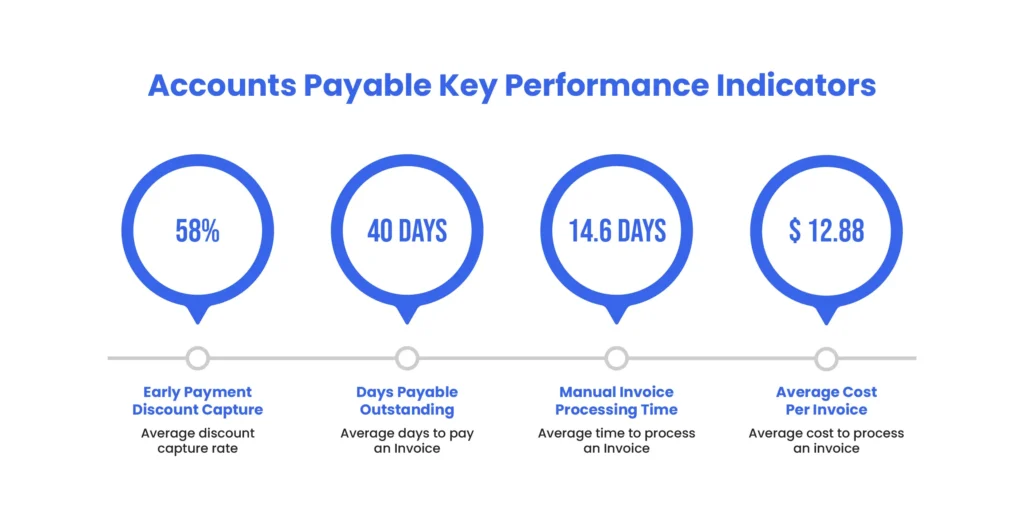
The manual processing time for an invoice is 14.6 days, 12.5% of which needs to be reworked. For a company that processes 5,000 invoices per month, the rework is 625 invoices needing to be reprocessed. Each one of those is a potential late payment. Every vendor conversation is one you don’t want to have.
Invoice approval times have fallen from 3.7 days in 2024 and were down to 3.2 days for leading teams in 2025. PLANERGY Software But for paper-based companies, the sky’s the limit. It takes almost 25 days for an AP team to process paper-based invoices. That’s almost a month between invoice receipt and payment approval ( plenty of time for vendor relationships to sour, early payment discounts to pass, and cash flow to be a mystery)
It’s particularly painful for retailers and manufacturers. A medium-scale apparel manufacturer with 40 to 50 vendors across three continents doesn’t have 25 days to process its invoices. Terms are typically set for 30 or 45 days net, which means that a manual process takes up most of that time before approval to pay the invoice.
Days Payable Outstanding: The Strategy Metric
Days payable outstanding (DPO) is a metric AP teams know well but don’t necessarily use strategically. The American Productivity and Quality Center puts the average DPO at 40 days. But averages obscure a lot of nuance.
Apple’s DPO has been over 100 days from 2017 to 2019, which is good for its short-term cash position. It’s due to the company’s unmatched bargaining power with suppliers who compete to supply parts for Apple’s products. Most companies aren’t Apple. But the theory holds that:
A well-managed DPO means more working capital, more flexibility, and more bargaining power.
DPO optimal is a moving target. A high-growth tech firm with strong cash flows might extend DPO to hoard cash. A company that relies on a few key component suppliers might pay quicker than its terms, to bank on goodwill. The point is that it’s a decision. It should not be a reaction to slow processes.
Early Payment Discount- A Catch Usually Missed!
This is a metric that most AP teams understand, and few maximize. The Institute of Financial Operations and Leadership (IFOL) reports AP teams capture just 58% of early payment discounts, on average. Centralized and automated AP teams capture between 85% and 95%.
Consider the impact of that difference. If you have a supplier that offers you 2/10 net 30 terms (2% discount if we pay you in 10 days), that doesn’t seem like much. But on $10 million of business with that supplier, 2% is $200,000. Every company has scores of suppliers with discount terms in the footers of their invoices, lapsing because AP didn’t act on them.
Companies that automate their invoice processing are capturing discounts 35% more often than those that do it manually. This is one of those cases where tracking the KPI makes the ROI case for process change irrefutable. The discount capture rate is not only a measure of efficiency, but it’s also a measure of revenue that most CFOs have never measured before.
Invoice Exception Rate: The System’s Canary
Almost 40% of your bills aren’t right almost 40%. If you don’t know what the exception rates are (the number of invoices that must be manually processed because of a mismatch, lack of purchase order number, data entry issues, or approval issues), you don’t know how much time your people are spending working on the problem instead of the solution.
Exception rate is particularly important because it’s the outcome of your vendor management, procurement, and AP processing coming together. If your exception rate is high, it may be that your purchase orders aren’t being raised in a consistent manner, or your vendors aren’t adhering to the agreed format when they send through their invoices, or you aren’t setting up your three-way matches particularly tightly. Your solution depends on the cause.
Recently, a large supermarket retailer in the UK attributed a significant reduction in AP staff to dropping their exception rate (invoices that don’t follow the standard process) for their invoices from 22% to less than 8% by automating their vendor onboarding process and moving to e-invoicing. That’s not an automation story. It’s a measure of exception rates – the metric led them to the solution.
AP Staff Productivity: The Benchmark Most Teams Avoid
Using a fully automated process, an accounts payable FTE will be able to process 23,333 invoices annually, whereas a manual process will be able to process 6,082 invoices annually. That is no little difference. It is a baseline distinction of what your team is capable of.
By 2024, 52% of AP teams continued to spend over 10 hours a week to process invoices and 60% continued to key the invoices into accounting systems manually. You add in the cognitive cost of manual data entry (context switching, error correction, approval chasing), then they are high-value hours.
The metric of invoices processed per full time equivalent (FTE) is how leadership teams can be made aware of whether the team is properly staffed to the work volume, and whether their investments in technology are indeed moving the productivity needle. It is the figure that causes the argument of automation to cease being because we probably should to this is the opportunity cost of not doing so.
Fine Tuning the Metric- A ‘Metric’ No One is Measuring
Finance chiefs know KPIs matter. They know the benchmarks exist. But if you only automate some of the process, you only get some of the data – some in the ERP system, some in emails and spreadsheets – and it’s hard to track KPIs that way.
The companies addressing this issue have decided to treat AP performance as a set of metrics that must be tracked, reported, and improved on a regular basis – just like sales measures, pipeline, or operations measures yield. Accounts payable KPIs are not just reflective of current performance. They are predictive and prescriptive, helping AP teams get better.
Conclusion: KPIs Don’t Improve AP. Acting on Them Does.
Let’s close with the truth. Accounts payable key performance indicators don’t save you money by existing. Cost per invoice in a dashboard isn’t going to help your cash flow. Days payable outstanding, calculated in a spreadsheet that no one looks at, doesn’t improve vendor relationships.
What KPIs do – when you pay attention to them – is replace the guesswork in an area that has until now been largely based on intuition and panic at the end of the month. They tell you where your process is breaking before the vendor calls. They tell you how much money you are leaving on the table in discounts. They tell you if you have the right headcount for the number of invoices you’re processing, or if people are getting sick and exhausted.
Companies with controlled accounts payable identify key metrics, measure them consistently and act on them accordingly.
