

Industry research indicates that many small and medium-sized firms have a cash flow problem, not because they are not generating cash, but because they lack a clear, current view of their finances (Fund Invoice). Whenever the figures are late, incomplete, or incorrect, leaders may base decisions more on their intuition rather than facts. This affects the growth and development of the company.
In this article, we will categorize the basic bookkeeping services that every business needs to have a firmer financial base and confidence in their decisions.
Core Day-to-Day Bookkeeping Services
Bookkeeping enables the owners to remain compliant, have a true picture of the performance, and respond quickly to changes. Industry experience is important to have more accurate financial insights into your company. Experts can assist you in adhering to industry best practices and strategizing for your goals.
Here are the essential core day-to-day bookkeeping services:
Recording Daily Financial Transactions
Any business transacts a ton of business a day- sales, purchases, fees, refunds, and tweaks.
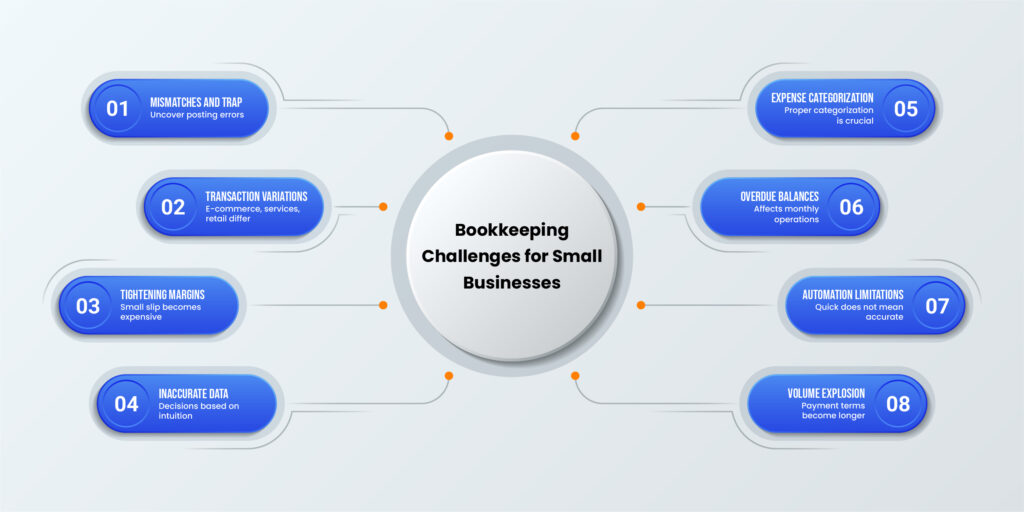
Industry-experienced bookkeepers are aware of the variations in the flow of transactions. E-commerce gentlemen are involved in payment gateways and third-party charges, service people are concerned with invoicing and time revenue (VJM Global). The current tools enable capturing the data more quickly, whereas experienced control allows marking the transactions as right and corresponding to your real activity.
Accounts Payable and Accounts Receivable Management
Maintaining receivables and payables is important for healthy cash flow. It involves managing vendor bills, discarding invoices, and pursuing overdue balances.
The payment terms and discounts are applied to wholesale or manufacturing. Slow client payments may affect monthly operations. Timing is adjusted to cash availability and day-to-day priority by automation flags, due dates, and reminders.
 Bank and Credit Card Reconciliations
Reconciliations ensure your books match those of the bank statements, cheques, and credit cards, which identify mistakes and duplications in remarks and rogue charges at an early stage.
Retail and hospitality industries are high-action sectors that require their reconciliations to be fast and frequent to identify discrepancies quickly. The use of automated tools helps in providing faster results.
Expense Tracking and Categorization
Good expense tracking has the money trail and puts the costs in check. It is also important that tax filing, budgeting, and profit analysis are properly categorized.
Various industries require various forms. The cost of goods sold is followed by inventory intensive companies; overhead and labor are found exclusively in services. The categories can be proposed with the help of automation, yet the appropriate bookkeeper ensures that the expenses are categorised properly.
Why Accuracy and Consistency Matter
Regular accounts enable you to have good, reliable fiscal information. Consolidated, modern records enhance the visibility of cash flows, enhance compliance, and reporting is not confusing as it should be.
Practical Tips for Strong Day-to-Day Bookkeeping
- Check bank and card accounts at the end of the month, or once a week when you have a high-volume business.
- Automation can be used to draw transactions; however, transactions should be manually checked regularly.
- It is advisable to keep business and personal expenses apart in order to avoid headaches.
- Definitive expense categories to which to remain.
- Monitor watch receivables to eliminate cash gaps.
Compliance, Reporting, and Financial Controls
Good bookkeeping is more than mere scribbling of the transactions: it keeps you in line, disciplined, and prepared to face any audit. The higher your rank becomes, the more you are expected to report, the stricter the rules become. Even minor oversights can become major issues at executive levels. Bookkeeping that is industry-sensitive brings sanity, accuracy, and visibility to all the financial records.
Monthly, Quarterly, and Annual Financial Statements
Raw data is transformed into understanding using financial statements. Frequent reports keep you on track with the performance, identify trends, and respond fast.
Sales Tax and Payroll Record Support
Interstate, inter-region, or online sellers encounter complicated tax regulations; payments should conform to labor legislation, benefits, and periods of filing.
E-commerce companies monitor tax within the storefronts and hospitality and manufacturing overtime, shift allowances, and benefits.
General Ledger Maintenance
The report is based on the general ledger. Good maintenance implies that the transactions are updated correctly, the accounts are balanced, and the changes remain consistent.
Internal Controls and Audit-Ready Documentation
Powerful checks prevent mistakes, fraud, and compliance violations. Audit trails become simpler with clear documents and standard procedures.
In industries that are controlled or fast-developing, investors, lenders, and auditors seek well-established controls. Automation may be used to automatically approve workflows and record keeping, whereas expert bookkeepers can create controls to shape your ledgers.
How These Services Reduce Risk and Improve Transparency
Regular adherence and disclosure provide a true and fair view of financial information. They indicate that the financial statements do not have any material misstatements.
Any financial issues are spotted earlier, before they become costly issues.
Practical Tips for Strong Compliance and Financial Controls
- Examine financial statements periodically.
- Maintain sales-tax and payroll, keeping them in order.
- Check and reconcile the general ledger regularly.
- Record approval and review processes in a simple language.
- Keep bookkeeping-backups in an accessible cloud system.
Advanced & Growth-Focused Bookkeeping Services
Basic bookkeeping will not suffice when the companies are expanding. New selling avenues, increased volume, reduced margins, and an increased number of people relying on the figures imply that you require bookkeeping instead of record-keeping.
Bookkeeping is a strategic instrument that can assist you in making wiser moves and developing sustainably.
Budgeting and Forecasting Support
There are budgets and forecasts, which enable you to plan and not scramble at a later date. They provide you with a financial plan of how to hire, purchase inventory, spend on marketing, and expand (Reach Reporting).
Inventory and Cost of Goods Sold Tracking
The ability to monitor inventory and COGS is the key to remaining profitable, particularly when you sell goods or produce them. Inventory management enables proper inventory tracking that allows the company to have optimum stock levels.
The multi-channel sellers have the added complexity of stock that moves between warehouses, platforms, and fulfillment partners.
A trained bookkeeper will select the appropriate tools like Xero, Quickbooks and others, adjust settings, and bring everything into order. So that it looks like your business is functioning as intended.
Why These Services Matter for Growing Businesses
Modernized bookkeeping transforms raw data into wisdom. To the multi-channel, fast-moving companies, such services provide control, predictability, and confidence- so that the leaders can grow in size without losing sight of their finances.
Practical Tips for Growth-Focused Bookkeeping
- Prepare budgets based on previous information and actual assumptions.
- Conduct periodical inventory and COGS reviews to defend margins.
- Get your accounting software tidied before you grow even bigger.
- Measures KPIs that advance your business.
Conclusion
Bookkeeping is one of the few aspects that permeate every financial decision you make.
Accurate records provide early warning signs and gaps that help companies take action early.
With proper documentation of effective records, leaders feel prepared to run swiftly, invest prudently, and endure some unforeseen shocks.
Ultimately, companies that maintain good bookkeeping have a tight rein on their numbers and are much better placed to become stable in the present and scale on purpose in the future.
