Planning & Analysis
Process Solutions


Get to know how ERP consulting and implementation services promote efficiency, visibility, and growth.
Why do CPG companies bet so much on ERP solutions?
CPG businesses face unique difficulties compared to other industries. Fluctuations in the prices of raw materials, multi-level production planning, compliance with legislation, and a multi-channel distribution channel, to name a few. McKinsey & Company’s research shows that companies that adopt a unified ERP solution record as much as 20% increase in inventory accuracy and a decrease in operational bottlenecks.
ERP systems integrate information within the financial, production, sales, and logistics sectors. They enable quicker decision-making, better cost control, and increased capacity to react to market dynamics.
CPG companies can engage the services of ERP consulting and implementation firms to seek professional advice on:
These services offer viable intelligence that enables a company to be more creative and grow in a highly competitive business environment.
The consumer packaged goods companies are unique in their accounting challenges. Thus, ERP consulting is required. Supply chains are affected by high levels of changes in consumer preferences, promotions by season, and product recalls. These factors force companies to launch new products in the market tentatively.
For example, a snack company launches a limited-run flavor across multiple stores. As a result, production, inventory, and distribution must be synchronized. Without a cohesive system, production can occur in one region while demand is strongest in another. Warehouses may overstock in slower-moving markets, while high-performing locations face stockouts. The scenario will result in a negative impact on revenue and brand image.
ERP consulting determines these pain points and makes sure that the system caters to them in its early phases.
Prior to choosing an ERP, consultants analyze the existing work processes in finance, manufacturing, supply chain, and sales. The problem with siloed spreadsheets is that they create inefficiencies and errors in demand forecasting or tracking trade promotions.
Process mapping can help consultants find the gaps in the processes, such as delays in reporting on production or uncertainties about what is in the inventories at the distributors. Objectives are then established. Examples include more visibility of margins, inventory tracking, or improved trade promotion management. For instance, a beverage firm may want to conserve 15% of expired stock through tracking expirations and batches in its ERP system.
One should choose the right ERP platform. Clouds offer scalability and real-time analytics. Functionality specific to CPG, like batch tracking, shelf life, and multi-channel order processing, gets priority.
It is also important in data preparation. The product, supplier, and customer master data will be accurate, so that the ERP delivers actionable insights.
Also, the quality of data can be low and result in incorrect procurement or cancellation of shipment, and undermine the OI of the system.
A good ERP roadmap is not only ambitious but also realistic. It offers a plan of system configuration, system integration with existing tools, employee training, and gradual go-live.
As an illustration, a multinational snack manufacturer can also apply the ERP finance modules, and then production planning and supply chain modules, with only a little disruption in operation (McKinsey & Company).
The consultants also develop the business case and estimate long-run savings on costs, productivity, and scalability as reasons to justify the investment.
Inventory management within the CPG industry is more complicated compared to most other industries. The products are also likely to have a limited shelf life, need batch tracking, and have to meet labeling requirements.
By using the ERP, its configuration ensures that lot control and expiry-date tracking processes, as well as warehouse allocation, are configured correctly.
The example of a dairy company and the ERP usage is to trace the batches by production date and automatically resort to alerts that notify when the items are nearing the expiry date. This enables the dairy company to reduce waste and, at the same time, provide the retailers with fresh products.
Proper configuration reduces errors, enhances traceability, and helps in compliance with food safety standards.
ERP implementation needs to be implemented in a seamless manner with existing systems (McKinsey & Company). The existing systems are the demand planning systems, warehouse management systems, retail POS systems, and distributor networks.
As an example, a snack company can also link its ERP to its distributor portal in such a way that it automatically sends its inventory to the areas. This integration will enhance the precision of the forecast. It will help guarantee the on-time delivery during the high-peak hour of demand, e.g., during Christmas.
In ERP implementation, entity migration is a very crucial process. Migration of legacy information, in which the company maintains logs of inventory, suppliers, and a production schedule in a new ERP system, is a process that should be planned.
CPG companies often deal with large amounts of transactional data, and the quality of such information is essential to the operations; Any error in the migration process may interfere with operations (NetSuite).
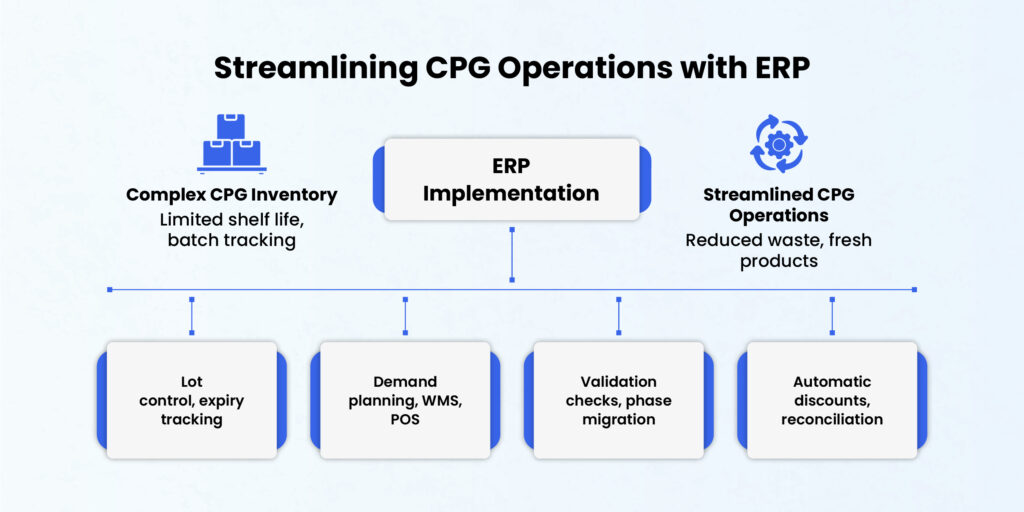
In the validation checks and phase migration, companies can keep their historical records, and at the same time, make the new system correct on the first day. As an illustration, when a beverage company decides to drop the use of spreadsheets and embrace the use of ERP, it can take its production batch data bit by bit by making sure that each batch remains verified before it becomes live.
The ERP systems enable CPG companies to be more effective in their trade promotions, rebates, and pricing policies. When implementing, the modules are set to handle the complex promotional campaigns with a proper application of discounts and records reconciliation.
As an example, a confectionery brand that has promoted to buy one and get another at multiple retail chains can enter all the transactions in the ERP system and automatically change the inventory and financial reports. This will remove mistakes in the manual and give insight into the ROI of promotion.
The ideal ERP system cannot work without adequate user adoption. The implementation plans should be trained on the plant operations, the finance teams, the sales staff, and the warehouse personnel. Test scenarios enable the user to get the idea of how the workflows work even before the system becomes effective.
For example, a packaged food company can offer the ERP to make test orders to guarantee that the batch tracking, warehouse distribution, and invoicing are working properly, and allow the staff to get used to the system under controlled conditions.
High-volume operations such as CPG are vulnerable to work interruptions during the ERP go-live. Part of the risk-reduction strategies is the gradual implementation of the new system, with the old systems running concurrently, and having a support team to deal with the problems at the earliest stage.
In the case of a beverage company, one can begin with ERP in one production plant and track the performance here, and repeat the same in the other plants after everything has settled.
Data-driven decisions made by the CPG enterprises are possible through aggregate tracking of key performance indicators (KPIs).
Indicatively, ERP dashboards may also assist a beverage producer to track the efficiency of production, batch yield, and timely delivery rates. The bottlenecks will be revealed with real-time visibility of these KPIs and will be utilized to optimize resources and enhance the level of service to retailers.
Over the long term, such monitoring can lead to actual changes in operational efficiency and customer satisfaction.
ERP systems provide data to enhance procurement, production, and distribution. An example is a snack company that can look at the utilization of raw materials, downtime, and warehouse throughput to see the operations that are not efficient.
Through this knowledge, the process may be redesigned to maximize waste reduction, reduce the lead time, and lower the cost of logistics. The need to maximize post-implementation will help ensure that the ERP system will still reach the real business gains even after the first implementation.
One of the most critical advantages of ERP in CPG is the improvement of the forecast of demand and inventory. With good forecasting, there will be no stockout or overstock, as is the case with fast-moving consumer goods.
For example, for a dairy producer, where the ERP data predicts peak demand during a specific season, align the production functions with the production runs, and set the optimal inventory levels (ResearchGate). It leads to higher inventory turnover, less obsolescence, and management of cash flow.
ERP systems allow businesses to monitor the margins and manage expenses in real time. CPG firms are able to make wise decisions concerning pricing and budgeting by examining the costs of production, costs of logistics, and the success of trade promotions.
A confectionery brand can use this to say, by product line and retailer, which campaigns are most effective, and which ones are providing the highest level of returns. This information-based approach improves cost management and aids in strategic decision-making of the business in the long run.
ERP is not a one-time investment. Access to better systems that can fulfill the changing demands of businesses requires regular system upgrades, enhancing their functionality, and providing support to the users.
CPG companies can increase the functionality of ERP to advanced analytics, demand planning based on AI, or integration of the e-commerce channel. Regular training and assurance are offered to maintain the efficiency of employees and enable them to achieve the potential of the system.
The ERP systems of CPG companies have to be processed in order to expand into new markets or channels.
As an example, a beverage company venturing into foreign markets can count on ERP to handle multiple warehouses, meet the local laws and regulations, and facilitate cross-border logistics.
Scalable ERP systems help a company to respond to changes in the market, responding to the changes effectively and without interfering with the business processes.
ERP systems used in the CPG industry are not merely IT projects but also operational efficiency, budget management, and decision-making drivers. They are smart to combine finance, production, supply chain, and sales into one source of truth and make quicker and smarter decisions.
To illustrate, an ERP dashboard employed by a beverage manufacturer may allow tracking production efficiency and inventory at different warehouses. It ensures that the promotional campaign is perfectly aligned with the stocks availaibility, so that there is no excess production or out of stock.
CPG companies need to target a number of practices that can be used to the fullest with the help of ERP. Clean up the master data before go-live;
Proper product, supplier, and batch data can save you money by eliminating production and distribution errors.
Second, train teams early and continuously, between the plant and sales personnel, to make them familiar not only with the system, but also give them the system in their day-to-day operations.
Third, actively implement ERP analytics; it is possible to monitor the KPIs (inventory turnover, production yield, and promotion ROI), streamline operations, and identify opportunities to grow. Finally, think of ERP to expand upon, not as something that can be bought and then dropped once: always optimize processes, seek new market avenues, and apply changes to your systems as you expand.
When ERP is implemented as a back-office tool and as a strategic facilitator, it will result in a competitive advantage. Combining operational discipline, data-driven insights, and continuous improvement helps CPG companies to minimize waste, maximize profitability, and be agile in the presence of changes in the market environment.
ERP transforms complicated processes into agile, measurable, and definite business value.