 Skip to content




Most industries track costs and call it a day. Energy companies track costs, lose half of them between field operations and the general ledger, scramble at month-end, and then wonder why the numbers never quite add up. That is a visibility problem, and the price tag on it is higher than most finance leaders are comfortable saying out loud.
When project data, field expenses, vendor invoices, and accounting entries all live in separate places with nothing connecting them, the finance team is chasing costs instead of tracking them.
Learn what energy cost tracking means, why it breaks down so often in this industry, what it does to cash flow and reporting, and how to fix it.
Need clearer energy cost visibility? Speak With an Accounting Expert
What Is Energy Cost Tracking?
Energy companies manage complex operations like multiple projects, vendors, field teams, and equipment all running at the same time. But when financial data doesn’t connect across all of these moving parts, cost visibility breaks down quickly.
That’s why businesses trust energy accounting services, as they play an important role, helping finance teams track where every dollar is going before small gaps turn into bigger financial problems.
How Energy Cost Tracking Gives Finance Teams Clarity
A solid cost tracking system gives energy finance teams a clear, real-time view of where the money is going across project-level expenses, vendor and contractor costs, equipment and maintenance, fuel and transportation, capital expenditures, and day-to-day operating costs.
- Capital expenses (Capex) stay separate from operating costs because mixing the two distorts both numbers and leads to bad decisions.
- Budget variances are tracked at the project and cost center level, not just rolled up at the company level.
- Cash flow pressure points are flagged early while there’s still time to act.
Without all of this in one connected view, finance teams are making decisions on data that’s already six weeks old. In the energy business, that’s too late.
Why Do Energy Companies Need Better Cost Tracking?
Tracking costs in the energy sector is complex. Expenses come from multiple directions like projects, vendors, equipment, and field operations, and they don’t always land in the right place at the right time.
The problem is that the data is scattered across disconnected systems and teams. And when that happens, finance teams are always playing catch-up.
Common Reasons Cost Visibility Breaks Down
Most energy companies know they have a cost visibility problem, but not always where it starts. It usually comes down to the same core issues like costs spread across too many projects, vendor invoices arriving late, field expenses lacking documentation, equipment costs poorly tracked, budgets never compared to actuals, and AP workflows with no payment controls.
| Problem | Financial Impact |
|---|---|
| Costs spread across projects | Finance teams struggle to see project profitability |
| Vendor invoices arrive late | Month-end close, and accruals become less accurate |
| Field expenses lack documentation | Cost coding and reporting become unreliable |
| Equipment costs are not tracked clearly | Asset profitability and maintenance costs become harder to review |
| Budgets not compared with actuals | Management misses cost overruns |
| AP workflows lack control | Payment timing affects cash flow |
Every one of those gaps is fixable. The fix starts with acknowledging that most energy companies are running a cost-tracking process designed for a business far simpler than theirs.
6 Ways Energy Companies Lose Sight of Their Costs
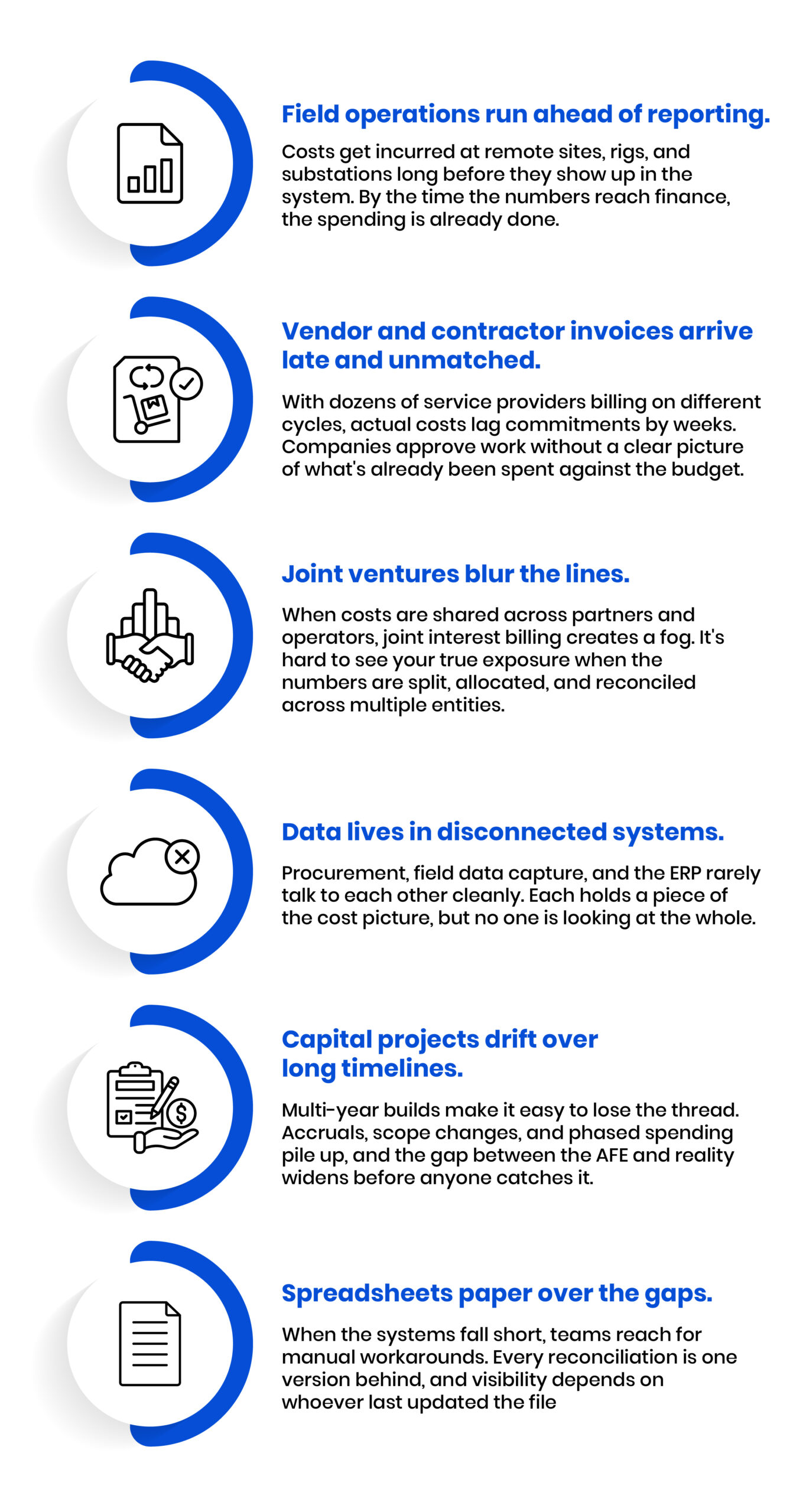
- 1. Field operations run ahead of reporting. Costs get incurred at remote sites, rigs, and substations long before they show up in the system. By the time the numbers reach finance, the spending is already done.
- 2. Vendor and contractor invoices arrive late and are unmatched. With dozens of service providers billing on different cycles, actual costs lag commitments by weeks. Companies approve work without a clear picture of what’s already been spent against the budget.
- 3. Joint ventures blur the lines. When costs are shared across partners and operators, joint interest billing creates a fog. It’s hard to see your true exposure when the numbers are split, allocated, and reconciled across multiple entities.
- 4. Data lives in disconnected systems. Procurement, field data capture, and the ERP rarely talk to each other cleanly. Each holds a piece of the cost picture, but no one is looking at the whole.
- 5. Capital projects drift over long timelines. Multi-year builds make it easy to lose the thread. Accruals, scope changes, and phased spending pile up, and the gap between the AFE and reality widens before anyone catches it.
- 6. Spreadsheets paper over the gaps. When the systems fall short, teams reach for manual workarounds. Every reconciliation is one version behind, and visibility depends on whoever last updated the file
Which Costs Should Energy Companies Track?
Not every expense carries the same weight, but in the energy sector, every cost has the potential to affect project profitability, cash flow, and financial reporting.
The key is knowing which cost categories matter most and making sure each one is captured consistently.
Key Cost Categories for Energy Companies
Every cost that moves needs a home. Project costs, equipment costs, vendor costs, labor costs, fuel and transportation, compliance costs, and capital expenditures each need their own tracking category that matches how the business actually operates.
According to the U.S. Energy Information Administration, equipment and machinery represent a significant share of upstream capital spending, which means cost pressure here shows up fast in financial performance.
Here’s what each category covers and why it matters:
| Cost Category | Examples | Why It Matters |
|---|---|---|
| Project costs | Materials, contractors, and field services | Shows project profitability |
| Equipment costs | Repairs, maintenance, leasing, depreciation | Shows asset cost pressure |
| Vendor costs | Supplier invoices, service providers, parts | Supports AP control |
| Labor costs | Field labor, overtime, project labor | Supports budget and margin review |
| Fuel and transportation | Fleet costs, fuel, logistics | Affects operating expenses |
| Compliance costs | Permits, inspections, reporting | Supports risk and budget planning |
| Capital expenditures | Infrastructure, equipment, upgrades | Affects cash flow and asset reporting |
How Poor Cost Tracking Affects Energy Financial Reporting
Financial reports are only as accurate as the data behind them. When cost tracking breaks down, it doesn’t just create messy books.
It flows directly into every report finance teams produce, making it harder to trust the numbers, close the month on time, or give management a clear picture of where the business actually stands.
Reporting Problems Caused by Weak Cost Tracking
Weak cost tracking spreads into every financial report the team produces. When cost tracking isn’t working properly, the damage shows up across every layer of financial reporting:
- Missing project expenses mean the numbers never tell the full story.
- Unclear cost centers make it difficult to separate what belongs where.
- Inaccurate accruals distort short-term financials and make reporting unreliable.
- Incomplete budget variance analysis hides cost overruns until they’re too big to fix.
- Late vendor invoices throw off accruals, turning month-end close into a guessing game.
- Weak project profitability reporting means leadership is making decisions without accurate data.
- Delayed management reports leave decision-makers waiting for numbers they needed last week.
- Incorrect cost coding sends expenses to the wrong accounts and follows the entry into every report it touches.
Why Reporting Accuracy Matters
As W Energy’s analysis of upstream operators noted, budget overruns go undetected longer, and cash flow shortages catch teams off guard when financial visibility breaks down.
That is the operational version of the problem. The regulatory version is worse. FERC examiners and SOX auditors spend real time in AP and cost records. When the records are a mess, the findings reflect that, and findings cost more to respond to than they would have cost to fix the process in the first place.
How Energy Cost Tracking Affects Cash Flow
Cost tracking and cash flow are more connected than most people realize. When costs aren’t captured accurately and on time, it doesn’t just create reporting problems, but it also creates real cash flow gaps.
Untracked expenses, late invoice entries, and weak AP visibility all affect when money goes out and how much is actually available to operate with.
Cash Flow Risks From Poor Cost Tracking
Cash flow problems in energy companies rarely show up as a single large failure. They show up as a series of small visibility gaps that compound over weeks until the pressure becomes impossible to ignore.
| Cost Tracking Gap | Cash Flow Impact |
|---|---|
| Late vendor invoice entry | Creates surprise payment obligations |
| Weak AP visibility | Makes payment scheduling harder |
| Untracked project overruns | Reduces available cash |
| Poor budget variance review | Delays cost-control decisions |
| Inaccurate accruals | Distorts short-term cash planning |
| Unclear capital spending | Weakens liquidity forecasting |
Energy companies already deal with cash flows that swing hard by season and commodity prices. A two-week payment delay at the wrong moment can strain liquidity across an entire quarter. Cash flow projections only work when the cost data feeding them is current and accurate.
How Energy Companies Can Improve Cost Visibility
The good news is that cost visibility problems are fixable. But fixing them requires more than just better software but it requires the right processes, consistent habits, and a clear structure that connects project, vendor, and financial data in one place.
Practical Steps to Improve Energy Cost Tracking
No single software purchase fixes a broken cost-tracking process. The fix is a process rebuild, backed by the right tools. Here is how energy finance teams do it.
- Define cost categories and cost centers that match how your operations actually run, not how a generic chart of accounts runs.
- Track direct and indirect costs separately from day one.
- Connect every vendor invoice to a project, department, or cost center before it moves toward payment.
- Review purchase orders before invoice approval. If the PO does not exist, the payment does not move.
- Reconcile project expenses every month-end. Not most months. Not when the workload allows. Every time, without gaps.
- Compare actual costs against budgets at the project level. Company-level budget reviews hide the overruns that matter most.
- Capital expenditures get their own category and stay there. Mixing capex with operating costs distorts both reports and every decision that follows from them.
- Before a major payment goes out, someone reviews the cash flow impact. This takes ten minutes and prevents the kind of surprise that takes a quarter to recover from.
- Month-end close runs the same way every single time. Same steps, same sequence, same people accountable. That is the only way the numbers from March mean the same as those from September.
- Management reports show what the CFO and project leads need to see, not what the software decided to put on the screen. If a report does not drive a decision, it does not belong in the pack.
Business process optimization support from a team that knows energy accounting makes this faster than building it from scratch inside a finance team that is already stretched thin.
What Role Does Accounts Payable Play in Energy Cost Tracking?
Accounts payable is more than just paying bills. In the energy sector, AP is the point where vendor costs, project expenses, and cash flow all meet.
When AP workflows are slow, poorly coded, or disconnected from project data, the entire cost tracking system feels it, from inaccurate accruals to delayed reporting to unexpected cash shortfalls.
AP Problems That Affect Cost Tracking
Every invoice coded wrong, every payment without a matching PO, every duplicate that slips through, all of it damages the cost data finance depends on for everything else.
Delayed invoice entry pushes costs into the wrong period and corrupts accruals. Incorrect GL coding sends expenses to the wrong account and project. Missing PO matching means payments go out for unauthorized work. Duplicate vendor invoices create overpayments that are costly to recover.
Weak approval workflows let invoices move toward payment without proper review, poor payment scheduling creates unnecessary cash flow pressure, and vendor reconciliation problems leave unresolved balances sitting in the ledger for months.
Why AP Controls Matter
According to Ardent Partners’ 2024 State of ePayables research, best-in-class AP organizations achieve touchless invoice processing rates above 70%, while the industry average sits below 30%.
That gap represents the distance between an AP function that supports cost tracking and one that undermines it. Energy companies need accounts payable services with the controls to close that gap.
How Budget Variance Analysis Helps Energy Companies Control Costs
Budget variance analysis gives finance teams a clear view of where actual spending is pulling away from the plan.
Catching those gaps early is what keeps overruns manageable before small budget gaps turn into serious financial problems.
Variances Energy Companies Should Monitor
Budget variance analysis is how energy companies find out whether their cost tracking is actually working. Without it, you have data, but with it, you have decisions to make.
Project cost variance, vendor cost variance, labor, equipment, operating, and capital expenditure variances each tell a different part of the story, and together they show exactly where spending is pulling away from the plan.
Here’s what each one reveals:
| Variance Type | What It Shows |
|---|---|
| Project cost variance | Whether project spending exceeds the budget |
| Vendor cost variance | Whether supplier costs changed |
| Labor cost variance | Whether staffing or overtime costs increased |
| Equipment cost variance | Whether maintenance or asset costs grew |
| Operating cost variance | Whether recurring expenses increased |
| Capital expenditure variance | Whether major investments exceeded the budget |
Financial planning and analysis services built for energy companies make this kind of variance reporting a weekly tool, not a quarterly exercise.
What Reports Help Energy Companies Track Costs?
Accurate cost tracking only delivers value if the right people can see the right information at the right time.
The reports a finance team produces and how consistently they produce them determine whether leadership can act on cost data or is simply sitting on it.
Useful Reports for Energy Cost Tracking
An energy finance team needs more than just data, it needs the right reports, running consistently. The project cost report, vendor expense report, and AP aging report keep day-to-day costs visible.
The budget vs. actual report, cash flow forecast, and capital expenditure report support bigger financial decisions.
The cost center report, equipment maintenance cost report, month-end financial reporting pack, and management dashboard bring it all together for leadership. These reports are only as good as the cost data behind them.
When Do Energy Companies Need Professional Accounting Support?
Most energy companies don’t realize they need better accounting support until the problems are already affecting decisions.
The signs are usually there long before that, they just don’t always get recognized for what they are.
Signs an Energy Company Needs Better Accounting Support
Most finance leaders know when their cost tracking setup isn’t working.
The signs are never subtle:
- Vendor bills are coded inconsistently, and project costs are impossible to separate from operating expenses
- Budget reports that don’t match actuals and AP approvals that are slow or unclear
- Month-end close is taking too long because cost reconciliation is always incomplete
- Cash flow surprises happen frequently because visibility isn’t good enough to see them coming
- Cost reports are dependent on spreadsheets, with finance and operations teams working off disconnected data
Each of these is a problem on its own. Together, they describe a finance function that is one bad quarter away from a serious incident.
How Expertise Accelerated Helps Energy Companies Improve Cost Visibility
What does it actually look like to fix energy cost tracking? It starts with a structured accounting workflow that connects field costs, vendor invoices, and project data to a general ledger that finance can actually use. That is what Expertise Accelerated builds for oil and gas operators, utility companies, and renewables developers across the United States.
Our experts provide professional accounting services to energy companies. We provide timely and accurate financials that help our clients have more visibility into their finances and make confident decisions.
The result is a finance function that knows where they are incurring costs, and it enables them to catch problems early on.
Get clearer energy cost tracking, reporting, and cash flow support. Book a Free Consultation
FAQs About Energy Cost Tracking
What is energy cost tracking?
Energy cost tracking is the process of recording, categorizing, and monitoring all operating costs, project expenses, vendor payments, equipment costs, and capital expenditures across an energy company’s operations. The goal is to give finance and operations leadership a current, accurate picture of where money is going, broken down in ways that support real decisions.
Why is cost tracking important for energy companies?
Cost tracking is important for every energy company because energy operations generate costs from dozens of sources at the same time. Field services, contractors, equipment, fuel, compliance, and capital projects, spread across multiple basins, entities, and project phases, all run in parallel.
Without structured cost tracking, project profitability is invisible, and cash flow management is something the team does reactively instead of proactively. The complexity of energy operations makes cost visibility non-negotiable.
What costs should energy companies track?
Materials, contractors, equipment, labor, fuel, compliance, and capex. Each one needs its own coding standard and its own place in the reports. Mixing capex with operating costs and the reporting problems that follow do not stay small. They build on each other until the financial statements tell a story nobody can fully explain.
How does cost tracking improve financial reporting?
Accurate cost tracking feeds accurate GL entries, which produce accurate financial statements. It eliminates the guesswork around accruals that comes from late or missing cost data. It gives finance teams the budget variance data they need to produce meaningful management reports. And it creates the audit trail that FERC examiners and SOX auditors require.
How does accounts payable affect energy cost tracking?
Every invoice that gets coded wrong in AP creates a cost tracking error. Every duplicate payment creates a cash distortion. Every delayed invoice entry creates an accrual gap. AP is the last point of control before costs hit the ledger, which makes AP discipline directly connected to cost tracking accuracy. According to IOFM research, organizations using automated three-way matching reduce invoice exception rates by up to 60% compared to manual operations.
When should an energy company get accounting support?
When the month-end closes consistently, it takes too long. When cost reports depend on spreadsheets that one person maintains. When budget variance analysis is not happening regularly at the project level. When AP approvals are slow and undocumented. When cash flow surprises stop being exceptions and start being the norm. At that point, the business is paying for the problem either way. Professional accounting support just means it gets fixed instead of repeated.
