 Skip to content


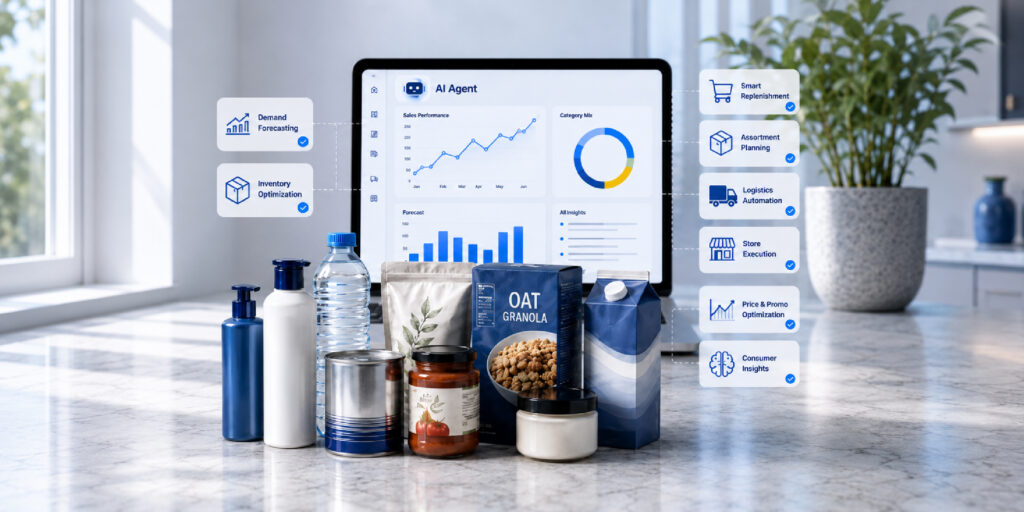
Consumer packaged goods (CPG) brands are using AI agents to automate complex business processes, analyze enterprise data, recommend actions, and execute workflows across finance, sales, supply chain, customer service, and retail operations.
Instead of simply responding to prompts, AI agents can analyze information, take action, and support business decisions within defined guardrails.
The real value isn’t in automating entire departments. It’s in removing the repetitive operational work that delays decisions, creates bottlenecks, and keeps skilled teams occupied with low-value tasks.
That’s where automation belongs. The work that is burning out your best people.
This guide explores how CPG brands are using AI agents today, where they’re delivering measurable business value, and how similar opportunities may exist across your own finance and operations workflows.
What Are AI Agents in the CPG Industry?
AI agents are influencing workflows across the CPG business. They can perceive and understand the context of the process. Their ability to reason about how to solve a problem and plan it in action makes them a big advancement in artificial intelligence.
AI agents can use tools as they understand multimodality information. In the CPG world, this means that they can go beyond simple chat. For example, they can monitor inventory movement and draft re-routing orders that humans just have to approve.
AI Agent Use Cases in Consumer-Packaged Goods
From cash flow forecasts, to managing inventory, demand and supply signals, to optimizing trade promotion spend. Companies are embedding AI agents across their operations to plan, execute, and tune decisions in real time.
Context assembly
The biggest impact is AI eliminating the setup work before any task begins. Today, before a brand manager or supply planner answers a single question, they open five tools: Nielsen, the retailer portal, the internal BI dashboard, SAP, and email.
The context gathering can take time (10 to 15 minutes) before a person can decide. Agents can save this time by assembling that context automatically, so the person reads a pre-brief summary instead of hunting for inputs
Repetitive Task Specific Agents
In CPG, the agentic AI that’s delivering value is much smaller, boring, but useful. Think about the work that eats up hours in a typical CPG ops team, such as:
- Transcribing retailer deduction documents and validating them against trade promotion planners, proof-of-performance documents, and promotional contracts
- Reconciling and consolidating inventory across a dozen warehouse portals and accounting reports, twice a day.
- Standardizing data from multiple sources with mismatched product codes and naming conventions
- Chasing down, validating, and disputing unauthorized retailer deductions to recover lost margin.
- Populating the existing spreadsheets and upload templates teams already use, without manual re-entry.
This is where agentic AI is winning in CPG right now. Narrow, task-specific agents that bridge communication and action. For instance, read the unstructured input, extract the relevant data, push it into the right system. No one would call any of these “agents that run the business,” but together they’re saving CPG teams a lot of time.
The bigger autonomous systems, the ones that promise to manage your entire trade spend or optimize your full supply chain end-to-end, still need too much babysitting to be reliable. The automation of repetitive tasks is working and providing value to companies, and that’s why they’re spreading faster.
How CPG Brands Use AI Agents for Retailer Deductions
Most CPGs lose 1–5% of gross revenue to invalid deductions. Recovery rates jump significantly when disputes are filed faster and with better documentation.
AI agents handle deduction intake, and document matching. Combined with our trade promotions management services, the result is faster recovery at the back end and fewer deductions on the front end.
Automating Deduction Document Processing
One of the most high-volume examples in CPG is processing the paperwork behind retailer deductions.
When retailers like Kroger, Walmart, or Target pay invoices, they almost always short pay. They issue chargebacks for promotional allowances, damages, shortages, or compliance fines and attach backup documentation explaining why.
Before finance can even begin to reconcile or dispute these chargebacks, someone has to read the paperwork and get it into a structured format.
The catch is that every retailer formats this paperwork differently, often across 150+ document templates pulled from retailer portals, and emailed PDFs, with roughly 10% arriving as scanned images rather than searchable text.
Most consumer packaged goods companies handle this with teams of transcribers who spend their days manually keying numbers from PDFs into Excel templates that are then uploaded into the ERP.
The transcription process is slow, expensive, and increasingly hard to staff. Keying numbers from PDFs all day is work few people want to do. And manual entry is prone to costly mistakes as well.
This is where AI agents for CPG finance teams break the bottleneck. They classify each incoming document, run OCR where needed, extract the relevant fields (invoice numbers, deduction codes, amounts, reasons, trade promotion references), and map them into the client’s standard template, flagging only low-confidence cases for human review.
The structured output then flows into whatever reconciliation, dispute, or accounts receivable workflow the finance team already runs.
For controllers, CFOs, and finance managers, the value shows up in two ways. First, staff shift from data entry to exception handling. Second, the deduction backlog clears faster, which means disputes get filed sooner, and cash flow improves.
AI agents for CPG deduction tracking is one of the low hanging opportunities for CPG finance automation.

How CPG Brands Use AI Agents for Trade Promotion Management
AI agents help consumer packaged goods companies plan, execute, and evaluate trade promotions.
Predictive AI (machine learning) handles analytical tasks such as:
- calculating reliable baselines from years of sales data,
- forecasting promotional uplift and profitability,
- spotting cannibalization between overlapping promos, and
- recommending optimal discount and mechanic combinations before a campaign even launches.
Generative AI layers on top as it guides users through TPM workflows, extracting product and price data from retailer catalog images, and surfacing competitor activity in real time.
Agentic AI takes it a step further by acting autonomously. They test scenarios, and executing routine trade promotion tasks without waiting for a prompt.
Used together inside one TPM ecosystem, these three AI types turn trade promotion management into a closed loop of planning, execution, and learning.
But, to use AI agents in TPM there has to be strong foundations in place:
- Structured data: Fragmented spreadsheets, inconsistent metrics, and disconnected retailer feeds will produce unreliable forecasts and shaky recommendations no matter how sophisticated the model.
- Guardrails for data security: Trade promotion data is sensitive. It touches customer terms, trade spend, margin structures, and retailer-specific agreements and AI agents acting on that data need clear boundaries.
Clear boundaries mean scoped access, audit trails, approval thresholds for high-value actions, and protections against data breaches to external systems.
Once the data and the guardrails are set up right, AI can help brands test new promo scenarios, adjust plans in real time, and save more money in the long term.
How CPG Brands Use AI Agents for Inventory Management
For CPG brands, products are constantly in transit between manufacturers, distribution centers, and retailer DCs. AI agents help teams track inventory movement and surface risks before they hit the P&L. Common use cases include:
- Stockout alerts before key SKUs run out at retail
- Overstock alerts that flag excess inventory tying up working capital
- Slow-moving SKU detection across DCs and channels
- Inventory reconciliation between ERP, warehouse management, and EDI feeds from retailer portals
- COGS change alerts when input costs or landed costs shift
- Demand change signals that flag unusual movement at the SKU or retailer level
Better inventory visibility helps CPG brands reduce missed sales, make sharper purchasing decisions, and protect working capital. It also takes a recurring source of manual work off finance and operations teams, who otherwise spend hours pulling reports and reconciling mismatches by hand.
Use Case: Catching Cold Chain Failures Before They Hit the P&L
A logistics manager at a mid-sized CPG company gets an alert. The reefer carrying $40,000 of frozen goods just spiked above safe temperature.
It used to be discovered too late, after the damage was done. Teams were manually checking truck temperatures throughout the day. However, often checks were missed especially as shifts changed. And when temperatures rose, no one knew until the product was already at risk.
The company needed a smarter way to protect their cold chain.
With an AI monitoring agent in place:
- Real-time alerts trigger the moment truck temperatures rose above safe thresholds
- Zero manual temperature checks required from logistics staff
- Preventable losses are avoided. There was no more spoiled inventory from missed readings
- The right team member is notified instantly, every time
Staff no longer spend their shifts watching temperature gauges. When something needs attention, they know immediately.
Cold chain monitoring is one example. The same approach extends across CPG operations. Agents catch errors in month-end closes, flag supplier delays, and route approvals before they stall. Wherever finance and operations managers are doing manual checks, that’s where AI agents earn their keep.
How CPG Brands Use AI Agents for Supply Chain Exception Handling
The pattern, agent does the work, human approves the decision, is showing up across replenishment, allocation, and exception handling in supply chain. It’s the closest thing to genuine autonomy in CPG ops today.
Instead of just receiving a “shipment delayed” alert, agents now check inventory at the destination DC, identify alternate sourcing, draft a rerouting order, and hand the human a one-click approval.
Finance Exception Alerts
Narrow use cases beat ambitious ones every time. Everyone wants an “AI analyst” but what is working is closer to smart monitoring. For instance, flag unusual invoice patterns, surface deduction anomalies, detect when a forecast is drifting from POS reality.
AI Agents for Shelf Monitoring and Stockout Detection
Agents process shelf images from store audits, detect out-of-stocks and planogram violations, and auto-generate work orders for field reps. This was one of the earliest agentic patterns in CPG and remains one of the most reliable.
Consumer Care and DTC Support
Conversational agents handle recipe questions, complaints, loyalty issues, and product inquiries on DTC channels.
2 Reasons Automation is Hard in CPG
Consumer packaged goods is a structurally complex business, and automating CPG workflows is hard for two reasons:
- Data is fragmented. It lives across the brand, the retailer, and third-party syndicated sources like Nielsen and Circana, so the integration work often matters more than the model itself.
- Domain expertise is scarce. Few engineers and AI specialists deeply understand the manual processes that run a CPG business, which makes it hard to know which workflows are even worth automating in the first place.
What Risks Should CPG Brands Manage with AI Agents?
The risks of agentic AI are already showing up. 80 percent of organizations have experienced unintended actions from their AI agents, including inappropriate data sharing, and unauthorized system access.
AI agents in a CPG environment are touching trade promotion data, retailer contracts, pricing tables, AR systems, and ERP records. For CPG brands, where a single unauthorized action could expose retailer-specific pricing or trigger a chargeback dispute, the risks needs active management and how soon you build the guardrails.
Poor Data Quality
Agents work in interconnected loops where the output of one becomes the input of the next. A small data error at step one does not stay small. It compounds, gets amplified, and by the time you see the result, the original mistake is buried under five layers of confident-looking work.
In finance and accounting, where every number rolls up into a reported figure, that compounding may turn a small data issue into a material one.
Data Security
Data security is still a big question mark right now when it comes to AI Agents, and the reliability of that data is in the hands of humans to scrutinize.
Agentic AI is new, and like every technology revolution, it brings new fraud patterns with it. But we have been here before. Credit cards, e-commerce, and mobile payments all started out “unsafe” before the right defenses caught up.
The same is gradually happening with agentic AI. We are building new guardrails and controls. So, the technology can be deployed securely and at scale.
Weak Audit Trails
Finance teams, controllers, and CFOs are unlikely to hand sensitive workflows to AI agents they can’t inspect. Audit trails give leadership the visibility they need to expand agent use with confidence.
An audit trail is a detailed, time-stamped record of every action an agent takes such as which data it accesses, which tools it calls, what decisions it makes, what inputs it receives, and what outputs it produces.
Regular audit trails help refine agent performance. Teams can analyze where agents make low-confidence calls, where they escalate to humans too often (or not often enough), and where guardrails need tightening.
Which CPG Tasks Should Stay Human-Led?
The simplest rule for deciding what to automate is to use AI where it compounds your margins instead of your risk.
For a CPG brand today, that means staying away from AI-generated brand imagery or holiday campaigns. Colgate’s recent tropical toothpaste ad is a good example. Viewers spotted the AI-generated visuals immediately, landing it on the growing list of failed AI ads and showing how fast automation can hurt brand reputation.
The real opportunity sits in the unglamorous work that drains time and money. Cash applications, inventory rerouting, first-pass matching, exception alerts, data checks, forecast updates, and task routing. That’s where AI agents earn their keep.
The line worth drawing is that AI agents should support the team and not replace financial judgment. Final approvals, deduction disputes, customer negotiations, accounting policy calls, promotion ROI decisions, and any strategic cash flow decisions should stay human-led.
Everything upstream of those decisions, the data prep, the matching, the monitoring, the alerts, is fair game for automation. That’s just good math, isn’t it?
How Can CPG Brands Start Using AI Agents?
If you’re an SME leader feeling overwhelmed by the AI hype, start with a strategy that applies AI only where it actually adds value.
Sit down with your team, talk about your workflows. Notice the repeatable tasks that nobody wants to do. Map the workflows that are costing you people, time, or trust.
Then bring in automation that expands what your team can do, with the guardrails that protect what you have built. This strategy shifts your team’s focus from repetitive daily tasks to the ones that are important in moving the business forward.
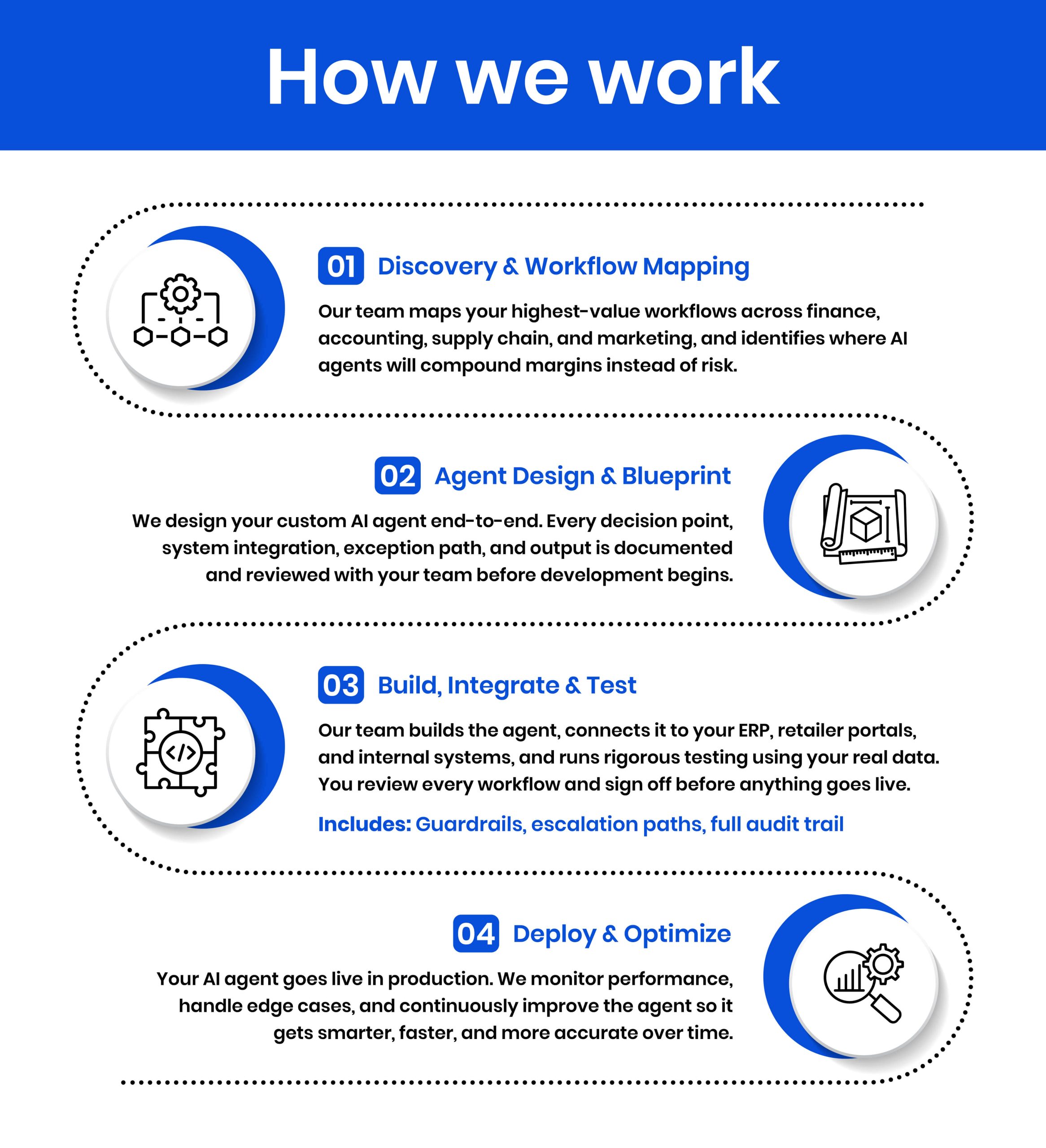
The infographic below shows how we put this into action, from mapping workflows to deploying agents with the right guardrails in place.
Conclusion
Most agentic AI use cases in CPG come down to one thing. They compress repetitive, low-judgment work like context gathering, data extraction, monitoring, and drafting. That frees people up to spend their time on decisions instead of prep.
But architecture matters more than the model. You need clear guardrails, defined escalation paths, and an audit trail for every action. Getting that right and the business results (efficiency gains, cost savings, faster resolution times, fewer errors) will show up on their own.
FAQs
Can AI agents help reduce retailer deductions?
Yes. AI agents classify retailer deduction docs, run OCR, and extract codes, amounts, and promo references into the dispute workflow. Backlogs clear faster, more disputes land in-window, and small-dollar items worth 20–30% of recoverable cash get chased instead of written off.
How do AI agents improve CPG cash flow?
AI agents improve CPG cash flow by automating the repeatable, high-volume work where staffing gaps and manual hours have been costing companies
Do AI agents replace CPG finance teams?
Agentic AI is useful for CPG finance teams, but mostly at the groundwork layer as mentioned above. Reconciliation, deduction processing, invoice matching, variance pulls, and first-pass commentary are some of the tasks that get faster with AI agents.
The catch is that it only works when your underlying data is sorted and your chart of accounts maps to how the business thinks. Otherwise, you get confident answers built on irrelevant information. And even with perfect data, agents cannot yet correctly answer the reason behind a volume miss, for instance. Or a margin compression due to a competitor’s promo.
